Maxime Gagné: The Art of Passing It On

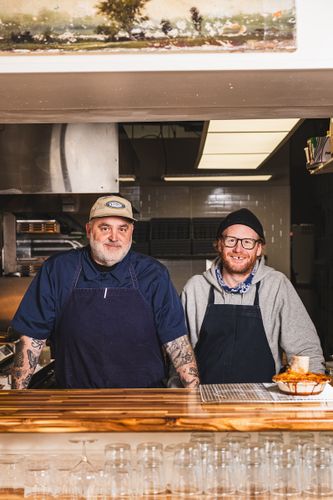
“Hey, chef!” Maxime Gagné still gets stopped on the street by faces he sometimes no longer recognizes. Former students who became cooks, sous-chefs, chefs. Some have listed his name on their CV, under “reference.” “He’s my chef from school.” For a man who spent eleven years teaching before betting everything on Mitch Deli, it might be the finest thing teaching left him.
The First Lessons in Hospitality
The youngest of four, Maxime grew up between a father from Rimouski and a mother from the Gaspé, herself one of fourteen siblings. His first taste of hospitality didn’t come in a restaurant, but in the Gaspé, at family parties. He remembers the coats piled on the beds, aunts and uncles turned into improvised maîtres d’hôtel, meals made as much for those staying the night as for those heading back home. No one in the family was a restaurateur; the art of hosting, though, was everywhere. “That’s kind of how I first tasted the restaurant world, through the idea of welcoming people.”
At the turn of the 2000s, he left home for Quebec City and enrolled at the École hôtelière de la Capitale. He cut his teeth at Chez Victor and Voodoo Grill, where he discovered something more than a trade. “Everyone stuck together,” he recalls. The kitchen became a place of belonging, a way to rebuild a family in a city that wasn’t yet his. It was also at Chez Victor that a whole world opened up: one of the few spots at the time cooking only with organic oils, mustards and vinegars, and serving responsibly raised beef in its burgers. “I find a lot of the values that spot held back then in Mitch Deli’s identity today,” Max tells us.
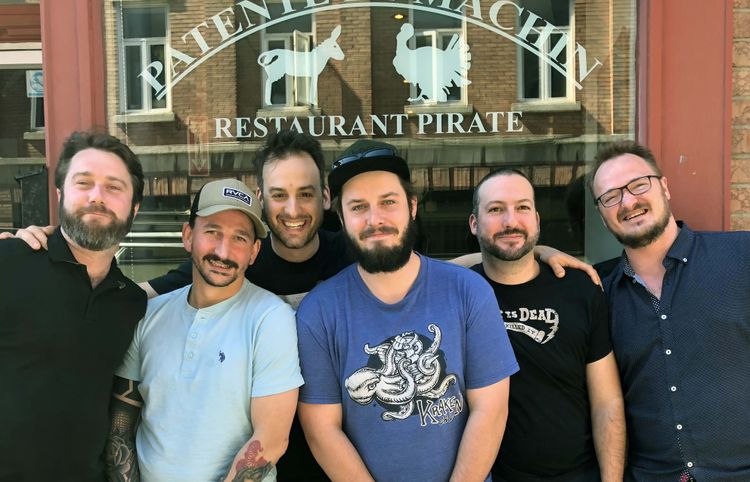
After four years in Quebec City, he came back to Montreal and moved through several kitchens before one name eventually took over the conversation: Le Local, Louis-François Marcotte’s restaurant, opened in 2008. Maxime was part of the opening team, then quickly became kitchen lead, alongside a crew that needs no introduction today: Élise Lambert, Isabel Bordeleau (Berto), Alexandre Gosselin (Chez Victoire) and others who would later fill the city’s finest kitchens.
A few years later, curious to find out “what making money in restaurants actually looked like,” Maxime went to work in Quebec’s Far North. The verdict was clear: the money came in, but the isolation wore him down. Far from his friends, on the margins of everyday life, he realized it wasn’t a life for him. Back in Montreal, he moved from kitchen to kitchen. That’s when a former Quebec City chef, Michel Poitras, came to recruit him to open a new cooking school. At first, Maxime declined: he was happy with his small team and had never thought about teaching. It would take just one broken promise, a menu he’d been assured would be alive before it was frozen in place, for him to come knocking on the director’s door himself. “You offered me something. Are you still interested in having me?” One trial class later, he was standing in front of his first group of students.
More Than 2,000 Cooks Under His Wing
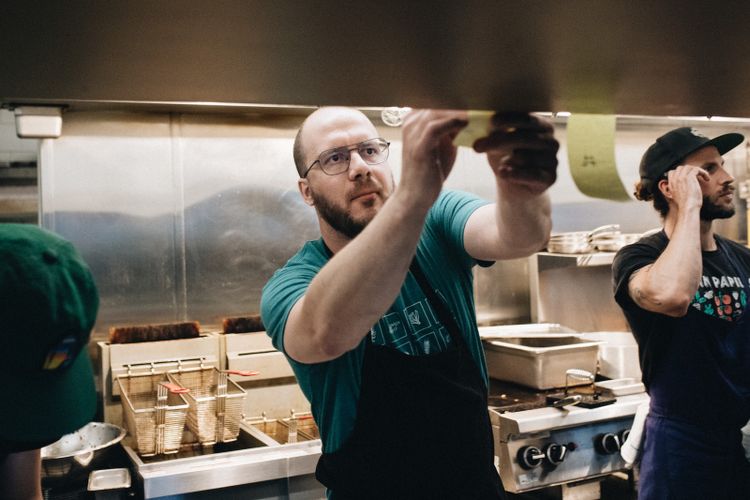
For eleven years, he taught cooking full-time at the École des métiers de la restauration et du tourisme de Montréal (EMRTM). “I trained 2,237 cooks,” he says, still amazed by the number. What moves him most isn’t the titles or the flawless career paths. It’s the bonds that remain.
“My first day was a disaster. I was reading off a PowerPoint, my voice was cracking, the class was silent. I must have been the worst teacher on Earth. At the break, I understood: I had to change my approach or I wasn’t going to survive. I came back in front of the students differently, with stories, parallels, pieces of myself. That’s when I felt something was happening.”
Maxime built the market cuisine program (charcuterie, sourdough bread, fresh cheese) with an ambition that often spilled past the boundaries. Because those boundaries were exactly what he eventually ran up against: the rigidity of a system where, he says, you had to “always fight to give students the very best.”
We owe you a generation of cooks; how does it feel to watch them excel?
“It’s so rewarding. It’s so cool to have access to these people.”
“I think especially of Anderson Lee, whose career is taking off at the helm of Oncle Lee. I knew him as a dishwasher at Provision, at 17. The kid wanted me as his teacher so badly that he enrolled at the EMRTM. Today, a week doesn’t go by without us chatting,” Maxime says. “Robert Santos is sous-chef at Pied de Cochon, Sébastien opened Louis XVI in Sherbrooke, I’ve got others at Monarque, Leméac, Molenne. I’m forgetting some, for sure, after more than two thousand students. But every one of those names moves me: it’s proof the work paid off.”
Maxime insists: he didn’t just teach, he learned. His classes sometimes brought together twelve or thirteen nationalities. On Fridays, he’d introduced the cultural staff meal: a student would cook a dish from home, and the whole class would share it. Haitian, Tunisian, Moroccan, Chinese, Japanese cooking. Duck tongues, lahmajoun. “These people brought me ways of thinking about cooking that came from traditions far older than our own. Really, they’re the ones who shaped the cook I am today,” he says.
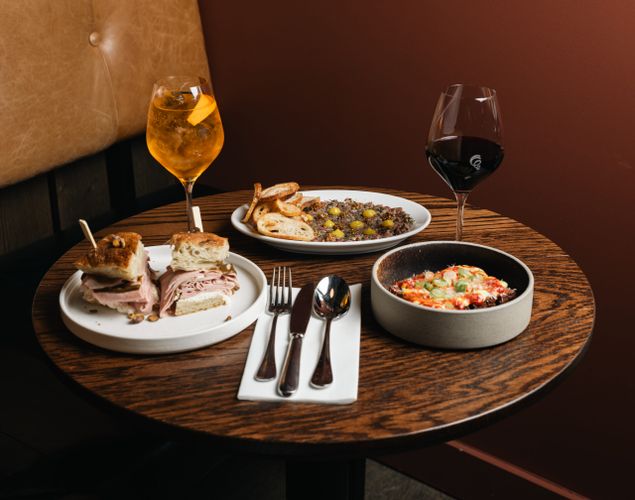
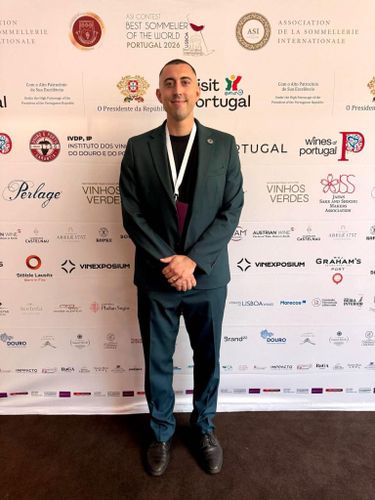
Through all of it, he kept working… (too much.) Sugar shack on weekends, side projects, a bachelor’s in education, sommelier training, openings. Maxime doesn’t really know how to stop. The pandemic hit at an already packed moment. He called two former students and launched a slightly crazy project: two sandwiches, chips, wine. What would become Mitch Deli was born in that stretch when everyone was gasping for air.
Mitch Deli, a Tribute to Michel
While the counter opened in spring 2020, inside the 180g record shop, its name is nothing like a marketing wink: it’s an intimate tribute to his father, Michel Gagné.
At the Gagnés’, you didn’t need to knock to come in. Michel cooked, hosted without ceremony, welcomed his son’s friends as if they were family. The conversation would stretch on, punctuated by a “You boys want a beer?” tossed out by Mitch. “Often, I wasn’t even there,” Maxime laughs. That instinct for welcome, he gets from him. That, at heart, is what he wants the Mitch to be: “a place of welcome,” in his father’s image.
Maxime, for his part, wishes he’d been more present. He admits it with regret: caught up in the trade, which he long “overvalued,” he didn’t take all the time he would have wanted with his father before cancer took him. Giving that name to his counter became both a tribute and a reminder to himself to take the time: “I still don’t take enough time to breathe, to live, and to enjoy the people around me.”
Mitch Deli 1.0 was an immediate success. Four days after opening, a New York web magazine crowned the Mitch the best new restaurant in North America. “Easy to say when you’re the only one opening in the middle of a pandemic,” Max tells us. Ève Dumas, of La Presse, had titled her piece “the sandwich shop of happiness,” Élise was writing about it on Tastet: it was full-on buzz. But what struck him most were the people who came and cried in front of the little sliding window. “I haven’t left my place in months, thank you so much for doing this,” people would tell him. In the thick of lockdown, a sandwich became a comfort. “It was so moving, and it really did everyone good at that point in all our lives.”
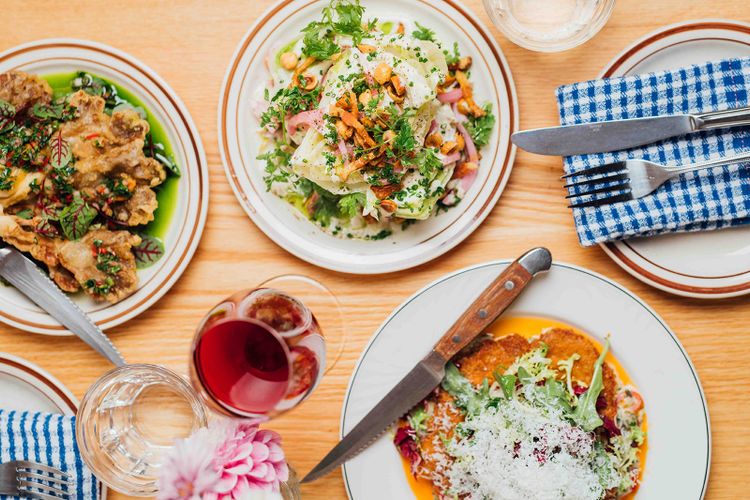
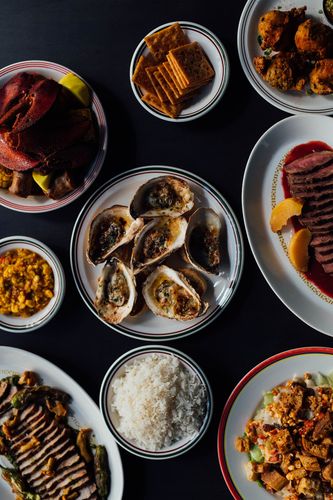
In 2022, the Mitch left the record shop window to settle on Beaubien Street. Everyone talks about its fried chicken sandwich, the house icon, one of the finest in the city. Its cellar now holds more than 200 labels, making it one of the neighbourhood’s excellent wine shops.
When Conviction Becomes a Stand
Maxime carries a conviction he struggles to put forward. And yet it sits at the heart of Mitch Deli’s mission. At the Mitch, nothing (not a wine, not an ingredient) comes in unless it’s at minimum organic. It’s not a pose; it’s an inheritance from his mother, Francine. The woman who crushed eggshells around her garden to fend off slugs and banished white rice from the table.
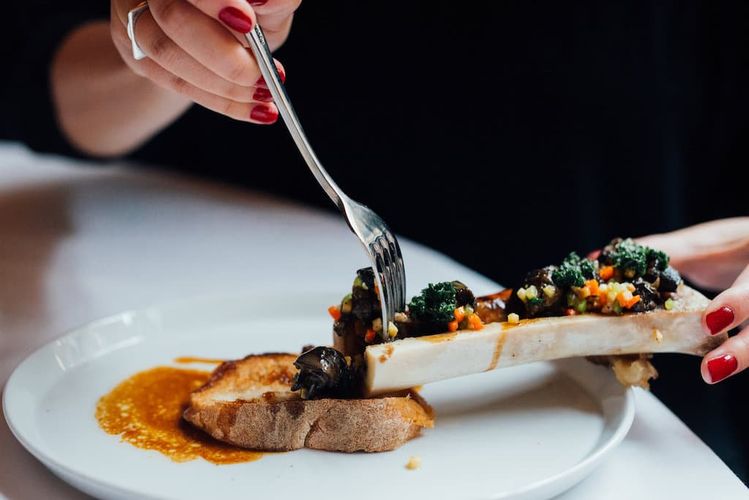
“An organic vegetable should never be called an organic vegetable. It should just be called a vegetable,” he says. “What they sell us at the grocery store should be called industrial farming.” He talks about pesticides, about cancer at 40, and admits that the Mitch’s stances are, for him, a way of doing politics. That conviction turns into concrete gestures and accessible prices: a plate of Gaspé halibut, 90 grams, for $25. Items at $9. Always an affordable glass of wine and an inexpensive draft beer. “I want people with less money to have the chance to come treat themselves. Eating well should never be a privilege.”
Rest Can Wait
You might have thought that leaving teaching would finally give Max the time to stop. That’s not knowing him. Mitch Deli is now on its 3.0 version, on Beaubien Street. Alongside that, he runs the kitchen at Microbrasserie Messorem, where he set up five years ago and where they sometimes serve 900 people in a single day. And since Max doesn’t know how to stop, two doors down from the Mitch, in early July 2026, he’ll open Café du Petit Musée. A 2,200-square-foot space where antiques sit alongside a coffee counter, and his mom’s cake recipes. Another way, perhaps, of keeping the door open. The way Mitch kept it.
If he had to do it all again, Maxime wouldn’t change a thing. “I think the most important thing is to believe in something and go for it. The best way to learn is to get it wrong, so get it wrong until it works.” And he adds, without false modesty: “I’m happy with my path. It’s not flawless, but I think if you never get it wrong, you never move forward.” (Maxime Gagné)
There are people we can’t wait to introduce you to. Max is one of them. His is, in fact, one of the portraits we’ve been asked for most. Max gives everything, his time as much as his words. Generous, wholehearted, outspoken and so easy to love, he’s the kind of guy we’d all want as a friend. It takes just a few minutes… (here, an hour and a half) with him to understand why everyone adores him, us first of all.
So treat yourself: go knock (or don’t, the door’s open) at 2660 Beaubien Street. You’ll surely walk out with a nice bottle in hand, a smile, and a full heart.
Written by Jean-Philippe Tastet
Photography by Alison Slattery