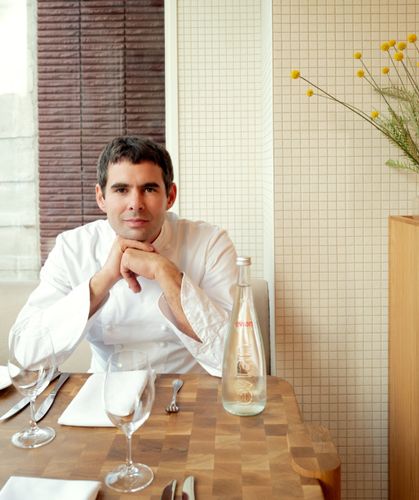
Mitch and Boom: the duo behind the MangeDansMonHood phenomenon

On Jean-Talon Est, the line starts at the door of the semi-basement and runs to the corner of the street. People wait an hour. Sometimes two. At the end of the wait: a smashburger. “People expect to take one bite and then do a backflip,” says Michel Lim (Mitch), half amused, half discouraged. “It’s still a cheeseburger…” he says humbly. At Tastet, we’ve eaten at MangeDansMonHood (very) often. Allow us to say that our taste buds really do backflips when we eat a smash there (!). Here’s the story of the duo we owe the best burgers in Montreal to, and another address we love: La Belle Tonki.
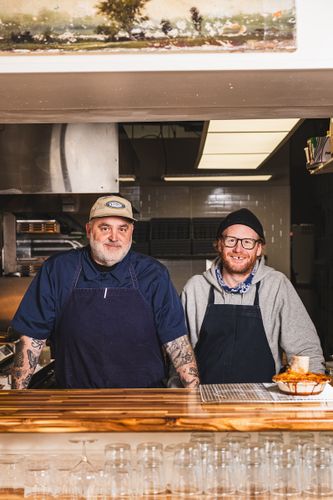
There are two of them, and they’re both named Michel (fate!). Michel Lim is Boom. Michel Nguyen is Mitch. They met at 15 through MSN friends they had never seen in their lives, back when that’s how you made friends. Boom was already breaking. Mitch learned from him, then dropped dance for weightlifting, convinced it would work better with girls. “I was wrong. I should have stayed in dance,” he says, laughing.
Thirty years later, Mitch and Boom are business partners and they sell up to 2.2 burgers a minute in a tiny space they had designed so they could have some peace.
Boom: from the stage to the flat top
Before he was a cook, Michel Lim was a professional dancer. Dance took him travelling, and everywhere someone would take him by the arm to bring him eat in their own corner. Cooking, for its part, was only a job to get by. His first position, at Tampopo on Mont-Royal, changed everything. “When I went to work, it didn’t feel like I was going to work.” He had always been distracted at school, and he had just found the one place that gave him no choice but to be present. “It was the only place where I felt like I was never bored.”
After a tour with his dance company, he applied to the ITHQ. Rejected, not enough kitchen hours on the clock. He landed in the first cohort of the brand new École hôtelière de Montréal. What he took from it isn’t a technique, it’s a vocabulary. “You take a piece of meat, you put it on a very hot surface, you want to create a crust. There’s a word for that: to sear.” And there, the dancer takes over again. “In dance too, there are foundations. You recognize that this is popping, that this is locking. It’s the same thing for cooking.”
It’s also at school that he understands, a few decades late, that his mother is a remarkable cook. “Mom’s dishes, there was no comparison.” He only got the full story as an adult: his mother’s father catered the banquets for every wedding in the village. “If I had known that when I was young, maybe I’d have made that choice earlier.”
Mitch: the son of La Belle Tonki
Michel Nguyen’s mother tried four times to leave Vietnam by boat before reaching Malaysia, then being sponsored to Canada. She wanted to be her own boss, and she became one. She’s also a strong, spontaneous woman who listens to no one. “She likes to do things her own way. But it’s admirable.”
Growing up in that gave him one single desire. “I just wanted peace. I wanted a 9 to 5. All I wanted was for people around me to be happy.” He becomes a CPA, an auditor, and does his friend Boom’s taxes.
In 2017, his mother’s restaurant is sinking. Everyone leaves, she cooks and serves at the same time. His plan was an accountant’s plan: turn the business around and sell it. He even paid for Facebook ads to beg people to come eat. It’s that post that made Boom appear, having just quit his job. “I’m free right now. I need a space to do my pop-ups, like a lab.”
They presented a menu to Mitch’s mother, sitting at the round table that stood there back then. “Me, a real manager. Him, a real cook.” And she said, just like that, spontaneously: why don’t you take over the business with your friend?
What they broke to become themselves
The first real click wasn’t a dish. It’s the day they admitted they didn’t like what they were doing. The traditional, melancholy music in the room. The authentic food served as is, without their own touch. “We’re children of immigrants. We’ll never cook the same food as the people back home. Why compete against them? We’re just going to do what represents us. Be Montrealers.” La Belle Tonki was born of that refusal.
Although the duo is stronger than ever today, the road wasn’t without obstacles. In 2019, their bond was put to the test. “As friends, we got along great. As partners, it was a catastrophe.” And during that time, they weren’t paying themselves. Not a cent. “I went from an excellent salary to zero. I had a wife who supported me.” Boom, for his part, was in his early thirties, with no income, living above his parents’ place for almost nothing. They sacrificed everything.
What saved Mitch and Boom was a conversation. “We took a step back. We were freaking out over nothing.” Since then, they tell each other the real stuff. “I’d rather butt heads with Michel than have someone who never tells me anything. He’s my second wifey.” Boom puts it more calmly. “The fact that we often disagree, that’s our strength. It makes us question all the time what we could do better.”
The snack bar that was supposed to give them peace
The pandemic showed them one thing: the white tablecloths were suffering, but the snack bars were holding on. Three or four employees, a tiny menu, nobody to train. “We’re not that good at running restaurants,” says Mitch, without irony. “My life is a series of accidents.”
The burger wasn’t obvious, everyone was already doing them. The rule settled it: “As long as we’re doing something, we have to do it really well, even if it’s simple.” So Boom spent the pandemic grinding, with a KitchenAid he ended up working to death. He went all the way up to wagyu, then asked himself the real question: is that patty better than the one that costs a fifth of the price? The answer settled the concept. “It’s still a burger. People won’t pay $20 for a burger.”
Still, simplicity, for him, takes work. Chuck for the fat balance, but a monotone taste. Brisket, more iron-forward, with a hint of acidity. Short ribs for the beef. He assembles. “You don’t go that far for burgers. Me, I did.”
Fifth in the world, without raising a hand
On May 27, 2026, Time Out published its ranking of the 14 best burgers on the planet. Fifth position, between addresses in major capitals: the Happy Ending from Casse-Croûte MangeDansMonHood, Montreal.
The irony sums up the whole project. The Happy Ending isn’t even on the menu. Time Out described it as the secret order at a place that only makes two burgers and makes them very well. Two burgers. That was the plan. Stay small enough to never have to rack your brain.
What the two Michels didn’t see coming is what a ranking does to a sidewalk. “With the Time Out article, it kind of tripled,” says Boom. Then a widely followed videographer came by to film, and it quadrupled. “It’s crazy. People wait for hours.”
Mitch and Boom are still learning to juggle this praise and what it implies. A world ranking doesn’t sell a burger, it sells a promise. The longer the wait, the more the promise swells, and the more work the first bite has to do. He doesn’t want people arriving at the counter expecting a miracle, just a good burger.
A new normal
The little spot we loved at Tastet isn’t really a secret anymore, but we love it just as much. Since May, the guys have been working hard to adapt to their new reality, because the popularity, the hype, isn’t coming down.
Mitch calls it a Montreal duty. Feed more people, and make his city a place where you eat well, yes, but above all a warm and mixed place, in his image. Mitch and Boom have never claimed to have invented anything. They’re just two guys who like doing things well, and who want to do Montreal proud.
Bravo, Mitch and Boom!
Written by Jean-Philippe Tastet