Leandro Baldassarre: Toronto’s Iconic Pastaio
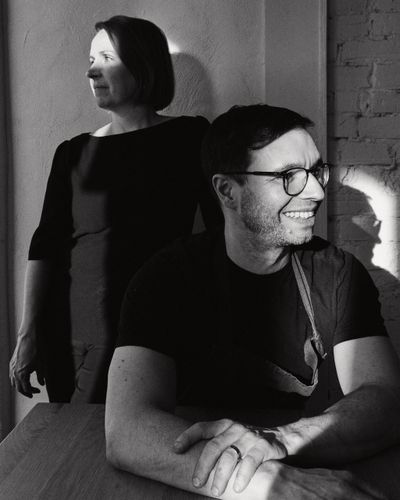
Leandro Baldassarre is one of the most quietly stubborn pasta makers we know. For sixteen years, out of a small Toronto kitchen called Famiglia Baldassarre, he’s been rolling, folding and drying pasta by hand — no fixed menu, no restaurant dining room, just a takeout container and whatever showed up that morning. He’s the kind of maker who’ll drive to Prince Edward County for the right pickerel and then sell you lunch for eighteen dollars, and if you ask him whether he’s proud of any of it, he’ll wave you off. We’ve met a lot of people who talk about doing things the hard way. Leandro is one of the few who actually lives there.
It’s a July morning in Toronto and he still doesn’t know what he’s serving for lunch. The garden behind the shop has finally started throwing off zucchini, and there’s mint out there too, so the answer settles itself: spaghetti, zucchini, mint — a Neapolitan dish he’s cooked since almost day one, bright and green and gone by early afternoon. “People are like, what’s for the menu next week?” he says. “I’m like, I don’t know. I have no idea.” That’s not a shrug. That’s the whole philosophy.
From a High-School Dropout to David Lee’s Line
He’ll tell you cooking was “a bit of a destiny situation,” but it didn’t look like destiny at the time. He dropped out of high school, a little lost, and walked into a kitchen at eighteen as “a last-ditch effort to try and figure out something to do.” The kitchen belonged to David Lee, then at Splendido, and something caught the moment Leandro stepped onto the line. “I was immediately sucked in,” he remembers. “It was very exciting to me. I was immediately disciplined and engaged.” Lee became a mentor, and more than that — “you almost feel like you’re leaving a parent,” he says of the day he finally left. What Lee handed him wasn’t a recipe, it was a way of working he still keeps: “always doing things the right way and never taking shortcuts, taking the path of most resistance.”
Three Years in Italy, and a Table Set for Twenty
In mid-2007, with a flight his uncle helped pay for and not much else, he moved to Italy. He’d never had “some dedicated professional interest in pasta, like, one day I’m going to make pasta for a living” — pasta was simply the wallpaper of an Italian childhood, something he’d rolled out casually beside both his grandmothers. Gnocchi with one. Ravioli, cannelloni and tiramisu with the other. Italy turned the wallpaper into a calling. He cooked in restaurants, absorbed the traditions of the Santini family, and spent his mornings over coffee with a landlady from Puglia who cooked with him every weekend. He learned about pasta, yes, but mostly about “family and culture and togetherness” — twenty people at a table, eating and working the farm together.
The irony wasn’t lost on him: he was learning the worth of family an ocean away from his own. When a close friend fell ill and his grandparents began to age, the distance stopped feeling like freedom. “You just get this feeling when you’re out there that it just feels pretty selfish,” he says. He came home in 2010 and started the business that February, at first just to “keep busy.” The name he gave it says the quiet part out loud — Famiglia.
Pasta for Your Mouth, Not for the Screen
For seven years he made nothing but pasta. No restaurant, no menu — just hands and repetition, “kind of like at school with myself,” drilling proficiency until it turned to reflex. He talks about the work the way a tradesperson talks about a trade. “It’s a type of work that you get better at only one way, and that’s by hours and hours and hours of repetition,” he says, and he means it literally: the same itch, he figures, that a person scratches doing stucco, or pipe-fitting, or sitting six hours straight folding ravioli. Cooking and pasta-making are two separate worlds he happens to weld together — “someone could be a great pasta maker and can’t cook worth a damn.”
What he won’t do is make pasta for a phone. “There’s a bit of a pasta community out there that’s all about pasta for screens and not for your mouth, which is not me.” What he chases instead is what he calls the “eatability” of a dish — how it all comes together at the end, how it meets a fork or maybe a spoon, how it’s going to be eaten and enjoyed rather than admired. His test for it is stubbornly analog: “If you close your eyes and feed yourself this thing, that’s how I adjudicate what’s good and what’s bad.” We’ll admit it’s a test we’d happily volunteer for.
No Menu Until Morning
That philosophy makes the kitchen harder than it needs to be, which is precisely the point. The menu changes daily, built around whatever showed up that morning — wild-caught pickerel he drives out to Prince Edward County to get, mushrooms from city foragers, herbs from the garden — worked by a small, skilled team into pasta and then, more often than not, packed into a takeout container and sold for eighteen dollars. Every dish has to clear a single question: what story is it telling? “Is it something you would encounter if that town was growing this vegetable or this fish?”
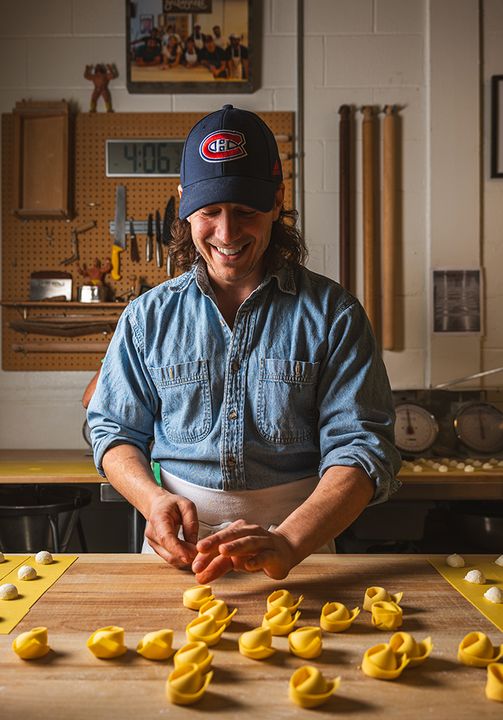
New ideas get fired up the night before or the morning of, served at lunch, then quietly weighed against the classics they’re trying to unseat. The ones that survive — the trofie with pesto, potatoes and green beans he flatly calls “a banger,” those little twists of pasta catching sauce in every groove — become a repertoire that only surfaces a few weeks a year, once the basil’s ready. Some days the standard means twenty people around a table for two days, folding tortellini for a single lunch service. “Not many people could do that,” he allows — about as close as he comes to boasting.
When the World Starts to Feel Like a Village
Ask him about pride and he pushes back on the whole frame. Sixteen years in, he has never once felt settled. “Every day you’re going into the unknown,” he says. “You open the doors and you just react to what happens.” Pride, for him, is a daily thing — banked at the end of a good lunch, gone by morning. What he’ll claim instead is the people. When he started he was “flailing,” too shy to phone a producer, nervous carrying a box of pasta into a stranger’s restaurant. Now his phone is full of numbers for everything: a broken fridge, someone to chop wood on a weekend, someone to fly to New York and eat pizza with. That, more than any dish, is what sixteen years actually built.
Fresh Pasta on Shelves, a Country Restaurant Someday
The dreams keep coming — most, he admits, are the beery, late-night kind that never leave the table. But one has turned into real work. For the last couple of years he’s been chasing something deceptively humble: getting fresh pasta into stores. It’s the hardest version of the idea, which is exactly why he likes it, and he’s selling to owner-operated shops he trusts, people “grinding away” for the same reasons he is. Further off, he pictures a small country restaurant one day — somewhere to drift toward when the city loosens its grip, “a nice way to take me to my grave,” he says, half-joking.
What frightens him isn’t failure. It’s the opposite. “The biggest killer of the heart in this industry is when you get into maintenance mode,” he says — when you stop adding to a thing and just keep it from falling apart. He wouldn’t wish a single shortcut on his younger self. If he could reach back to the kid too shy to phone a producer, he’d send him down the hard road on purpose — the failures, the scared phone calls, the seven years of nothing but pasta. That’s the whole point. “You can only get great by failing a lot,” he says. On his rare days off he drives to the country, mows grass on a tractor, drinks a beer, puts the phone away. “Just try to be human,” he says. Sixteen years on, the name over the door still means exactly what it says.
Written by Daniel Neuhaus
Photography by Scott Usheroff