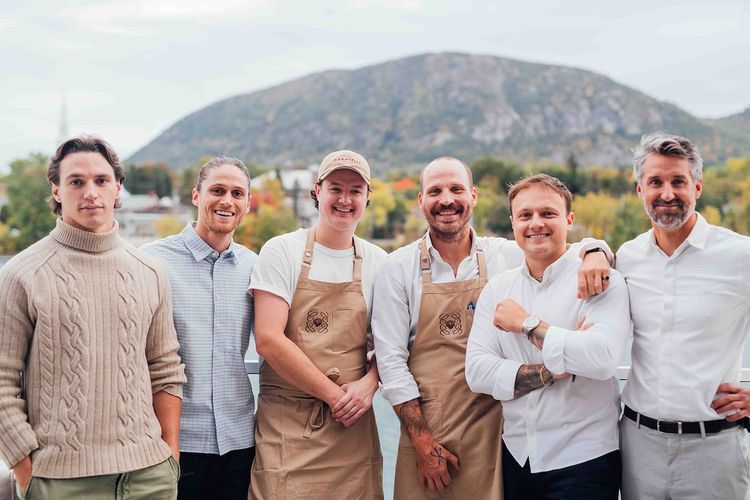
Scott Usheroff: Trading The Apron For The Camera

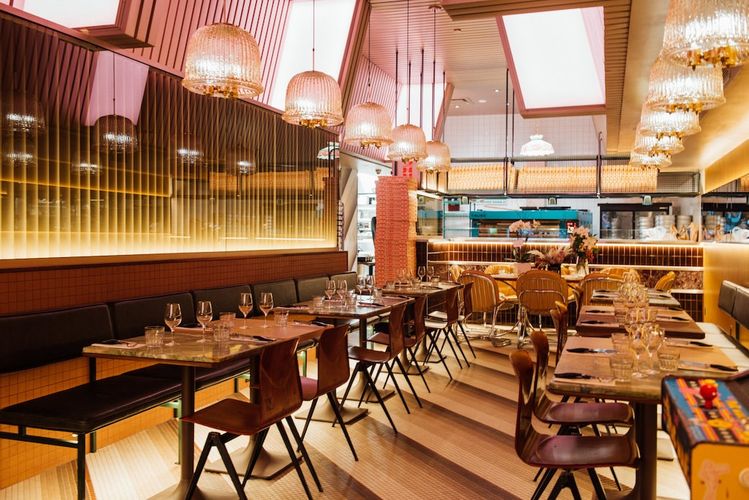
It’s late on a Saturday at La Spada. The last table has cleared, the line has gone quiet, and Scott Usheroff is doing the thing he loves most about the life he built: pouring leftover wine by the glass for the staff, letting the room finally breathe. A few years ago, this same man was sitting in his home office rolling out of bed right into the desk of his home office, writing user stories, feeling — in his words — “like a complete robot.” The distance between those two rooms is the whole story. And if you ask him the question almost nobody thinks to ask, he’ll tell you he’s happy now. “For the first time in a long time,” he says, “I’ve built a life that feels authentically mine.”
You might not guess any of that from across the street. Big guy, tattoos, a demeanor that reads as trouble. “Everyone thinks I’m a tough guy,” he laughs. “But I’m a softie. If you see me walking down the street with my chihuahua, you might think differently.” That gap — the hard exterior, the soft interior — is the engine of everything he shoots.
The cook who liked to take his time
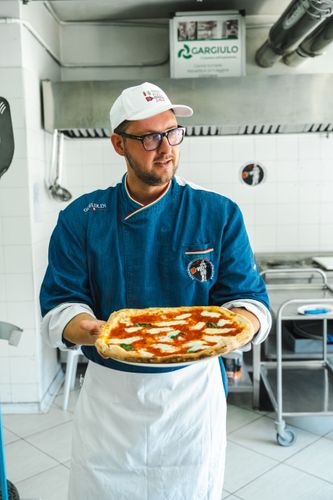
The kitchen came first. Cooking was always where his creativity went; numbers and classrooms never were. After a stint in English literature at university that he calls “probably the dumbest thing I could have done,” he found his footing at the ITHQ. “It was the most fun I’ve ever had at school,” he says — even as an anglophone navigating a francophone trade. From there came the real apprenticeship: a stage at Garçon! under Mark Gaffney who taught Scott many hard and important lessons, , a job alongside David McMillan at Rosalie’s, four years of late nights and the kind of pressure that lives in your shoulders.
He loved it. He just couldn’t keep up. “You have to have this inherent speed if you’re going to be a really successful chef,” he admits, “and I just wasn’t fast enough.” He liked to take his time. On the line, taking your time means falling behind. So Scott Usheroff made the first of several leaps — out of the kitchen entirely.
The robot in the home office
The leap landed somewhere unexpected: tech. Scott Usheroff spent thirteen years in the field starting as a product manager and finishing as a VP of product across various Canadian startups, building product with engineers and designers, scratching his creative itch in a new way. It was good to him, for a while. Then the industry shifted, then the pandemic hit, and the man who had once thrived on chaos found himself motionless behind a desk. “I had no passion left for it anymore.”
So he reached for a camera, mostly to get out of the house. He offered to help friends with marketing photos during the pandemic for free, just for fun and to help them through difficult times. He fell in love. The hobby quickly became a side hustle, the side hustle then became a question he couldn’t shake. He went back to school at night and on weekends, in commercial photography, to learn how to use light, lens, and camera properly. Then he took a terrifying leap: he walked away from the steady paycheck, the health insurance, the cushy chair. “I had severe anxiety for about six months,” he remembers. But once he committed fully to what he loved, “all these new doors started opening.” Eight months later, every penny he had went into a restaurant. The VP of product was gone for good.
Telling the story behind the pass
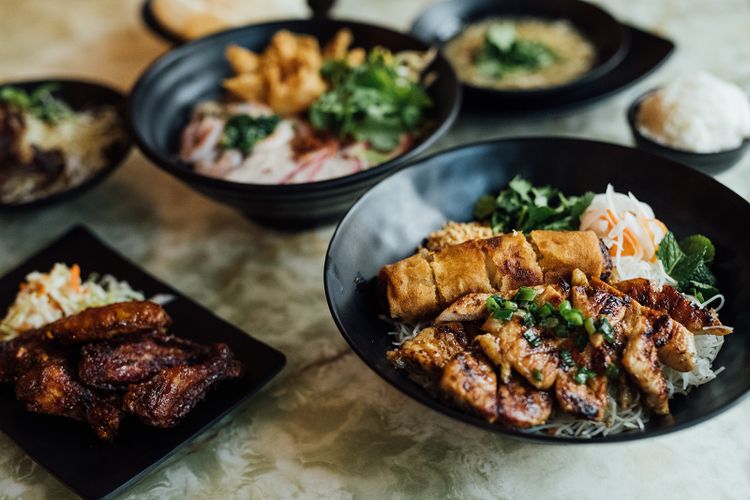
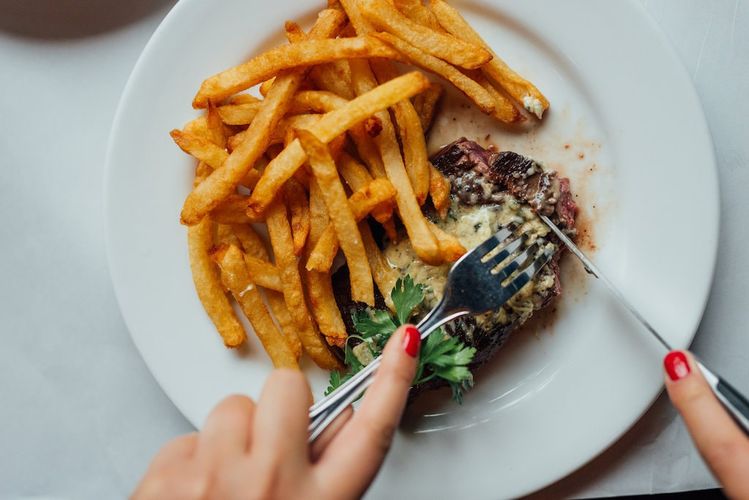
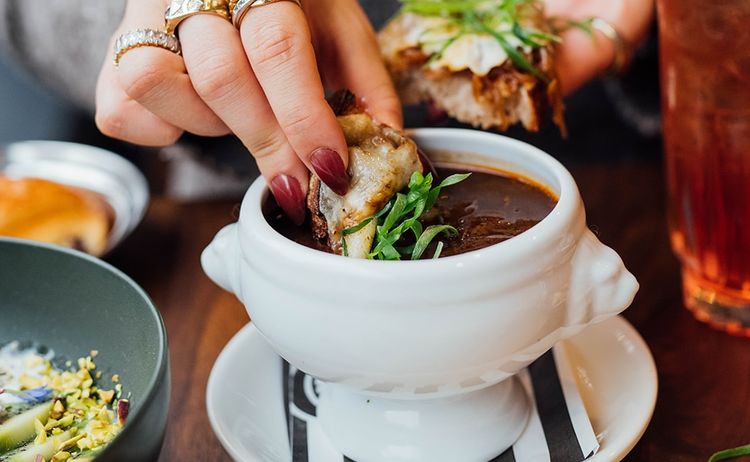
What sets Scott Usheroff’s work apart isn’t gloss — it’s warmth and dept. He shoots the food beautifully, sure, but his real subject is everyone around it. “I’m inspired by photojournalism and street photography, storytelling through the camera,” he explains. “It’s important to capture the beauty of the food, but it’s also super important to capture what’s going on behind the scenes. That’s where I thrive — capturing emotion, people in the kitchen during service, doing what they do best.”
Photography has never been just about making beautiful images for Scott. It’s about preserving the work, passion, and humanity of an industry that has given him so much. Restaurants, chefs, farmers, bartenders, servers, artisans, these are people who dedicate their lives to creating experiences that often disappear in a matter of hours. He see photography “as a way of giving those moments permanence and giving the people behind them the recognition they deserve. If my work can help tell their stories, celebrate their craft, fill their dinning room, attract new guests, or simply make someone feel special and proud of what they’ve built, then I’ve done my job.” The success of this industry is deeply connected to my own, so supporting the incredible people around me isn’t just something I enjoy—it’s a responsibility I feel privileged to have.”
His proudest moment so far had nothing to do with a plate. It was an exhibition called Behind: fifty black-and-white portraits of chefs, servers, owners, the people who rarely step out from under the heat lamps. “I know how hard it is to get chefs out of their restaurants,” he says. The night of the vernissage, so many of them came through for him. “I felt really seen, really rewarded.” He cares about the same thing on both sides of his double life. “I capture people’s work, I highlight them, I make them feel special. And that in turn, that makes me feel special.”
The recognition has stacked up fast for someone just a few years into the craft: a World Food Photography Awards finalist nod in 2024–2025, then a second-place finish the year after; a Leica Mastershot; three Canada’s 100 Best covers in 2026 for the entertainment, best bars,and best restaurants editions; three straight Cult MTL food-issue covers; and bylines in Food & Wine, Maclean’s, Nuvo, Elle, Ricardo and the National Post. He clocks each one, and then his mind moves on before he’s had a chance to sit with it — a habit that, lately, he’s trying to break.
The softie with the chihuahua
Ask Scott Usheroff what brings him joy and the answer is smaller still: his dogs, and making people happy. He learned young that he’s wired for instant feedback, the kind building SAAS apps never gave him.
None of it works without one person. “My wife, Tara — she gives me the space, the confidence and the love I need to be my best,” he says. “She’s a true partner, and she’s the love of my life.” He’s clear-eyed about the cost of a freelance camera career stacked on top of running a restaurant; some Sundays the whole job is telling himself to stop. “Okay, Scott. Take a deep breath. It really is a never-ending job.”
Every detour was the road
Scott Usheroff doesn’t measure himself against anyone — he stopped that a while ago. He’s inspired instead by the dishwashers, the servers, the owners who just keep showing up, because he knows exactly how hard that is. The principle he won’t bend on is honesty: “Everyone makes mistakes, God knows I’ve made my fair share. What’s important is that you’ve got to own those mistakes.” And if he could talk to his younger self, he’d tell him to stop bracing for one wrong move to ruin everything. “Life is way more forgiving than you think. Starting over isn’t the end of the story — it’s often where the story actually begins.” The detours, he’s realized, weren’t detours. “The things he thought were side quests were actually the road.”
The road keeps unrolling. There’s a cookbook in the works with Pizza 900, shoots that have taken him as far as Chamonix, a lot of back and forth to Toronto, and a second La Spada on the way — a sunnier, terrace-and-garden version of the room that started it all, the same room that landed on Canada’s 100 Best recommended list for 2026. “I’ve learned so much from the first one,” he says. “I’m hoping the second goes a little smoother. We’ll see if that holds.”
There is no finish line
Ask what he’s still trying to prove, and to whom, and the honesty turns inward. “I’m done trying to prove myself to other people — it’s exhausting,” he says. He spent too many years chasing approval, certain that one more accomplishment would finally make him feel like he’d arrived. Now he’s his own toughest critic. The restaurant succeeds and his mind jumps to what’s next. The photo wins an award and he wonders if it could have been better. “A dream becomes reality, and instead of sitting with it, I’m already questioning the next decision before I’ve celebrated the last one.” The person he’s still trying to convince, he admits, is an older version of himself who never quite believed he was enough. “What I’m learning, slowly, is that there’s no finish line. No achievement suddenly grants permission to feel worthy. The challenge isn’t proving myself anymore — it’s learning to appreciate what I’ve already built before racing off to build the next thing.”
Are you happy?
It’s the question he wishes more people would ask, because for a long time the honest answer would have been no. Not anymore. He’ll list the proof if you let him: walking into a full dining room and hearing the buzz, telling a story through a photograph that says exactly what he meant, pouring that last glass for the staff, a Sunday with Tara and the dogs and nothing on the schedule. Happiness, he’s decided, is a moving target — and he’s made peace with chasing it instead of waiting on it. “I’m still chasing the next thing,” he says, “and I’m no longer waiting for it to make me happy.” Awards fade, businesses change, photographs get forgotten. What he wants to be remembered for is simpler, and harder. “How I made people feel. That I showed up when it mattered. That I left places, projects and people a little better than I found them.”
Written by Valérie Boutet
Photography by Scott Usheroff