Maria-José and Zoya De Frias: Celebrating Life Through Cuisine

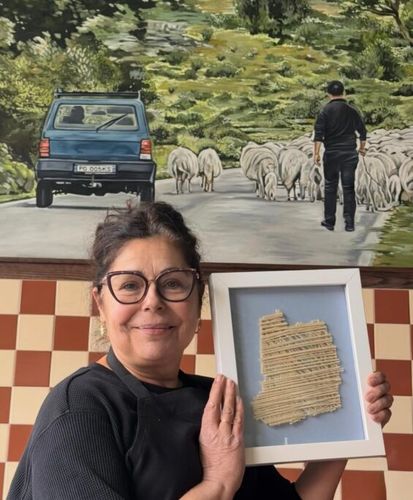
Some duos work because they’re alike, others because they complement each other. Maria-José de Frias and her daughter Zoya de Frias belong to the second category. “I’m the artist, she’s the mathematician,” Maria-José sums up with a laugh. Together, they helm Le Virunga, a pan-African restaurant nestled on Rachel Street East in the Plateau-Mont-Royal — but above all, they carry a story of resilience, transmission, and spontaneous celebrations around the table.
From Kinshasa to Brussels
The story begins in Kinshasa, in the Democratic Republic of Congo. Maria-José grows up between a Portuguese father and a Congolese mother, in a comfortable life shattered by the civil war of 1991. Like hundreds of thousands of Congolese, she flees the country with her two young children. What was meant to be a temporary stay in Belgium turns into a prolonged exile when returning home becomes too dangerous.
In Brussels, Maria-José reinvents herself as a fashion designer. But it is in the kitchen — the kitchen of her Congolese childhood, of large family gatherings — that her heart beats strongest. “We’ve always loved eating well, and especially sharing,” she says. “Sometimes, spontaneously at home, we’d say, ‘Today, we’re celebrating life!’ We’d call each other, gather, and cook a great meal. No special occasion — just to sit together and share good food.”
Zoya grows up within that cultural blend. Born in Kinshasa to a Congolese-Portuguese mother and an Indian father — a third-generation Congolese of Gujarati origin, and also Canadian — she embodies a rare identity from childhood. Her memories are sensory: pondu simmering on the stove that she wasn’t allowed to touch, long preparations, mountains of fritters, plantains, fufu, and grilled meats. “I’ve always loved eating,” she says simply. “When I was little, my favorite moment was going to a restaurant.” In a few words: abundance, flavors, aromas.
Montreal: A Spontaneous New Beginning
It is Zoya who nudges the de Frias family toward Canada, curious to explore another side of her paternal roots. “At first, I didn’t want to settle here because it was too cold!” Maria-José laughs. But Montreal welcomes her differently than Europe did. “In Europe, I wanted to study culinary arts, and they refused me because I was over 40. Here, there was no hesitation — everyone has the right to an education.”
She enrolls at LaSalle College and finally formalizes a lifelong passion. “The welcome I received from the community here was extraordinary. Everyone was generous. And I wondered what I could do to give back and show my gratitude. So I decided to share my culture.”
Zoya, meanwhile, takes a very different path. Studious and disciplined, she completes a double bachelor’s degree in mathematics, statistics, and computer science at Concordia University in 2015. She lands a job as an analyst but quickly realizes it isn’t her calling. “Real life discouraged me quickly. After three months on the job market, I felt like I’d already seen it all.” Zoya had never set foot in a restaurant kitchen and had no idea she would one day build a career in hospitality.
When asked when they first imagined opening a restaurant together, they answer in unison: “Never!” — laughing.
And yet, in June 2016, Le Virunga opens its doors on Rachel East. The name pays tribute to Virunga National Park in eastern DRC, a place of wild beauty known for its volcanoes and mountain gorillas — symbolizing the richness of the African continent.
Mother and Daughter, A Powerful Duo
Working together daily also means learning to see one another differently. For Maria-José, the initial challenge was trusting her daughter as a business partner. “Since the restaurant opened, I’ve watched my daughter grow, evolve, and become a woman. I’ve learned to respect her as a woman — I no longer see her as a child, even if in my mother’s heart she’ll always be my little girl. But here, she’s my little boss! She works hard, and I admire that. I’m blessed to see her thrive every day by working alongside her. Working together only deepens the respect I have for her.”
Zoya returns the admiration: “Her work ethic is contagious. I already knew she worked hard, but seeing it daily motivates me to do the same. When I see her working until 4 a.m., cutting her meat… I realize how much work it truly takes.”
Maria-José reigns over the kitchen; Zoya oversees the dining room and business operations. They complement each other perfectly: the artist and the mathematician, heart and structure.
A Cuisine of Love and Sharing
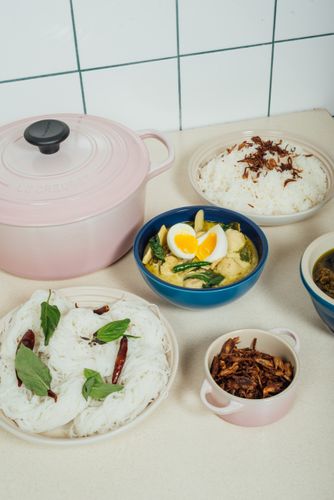
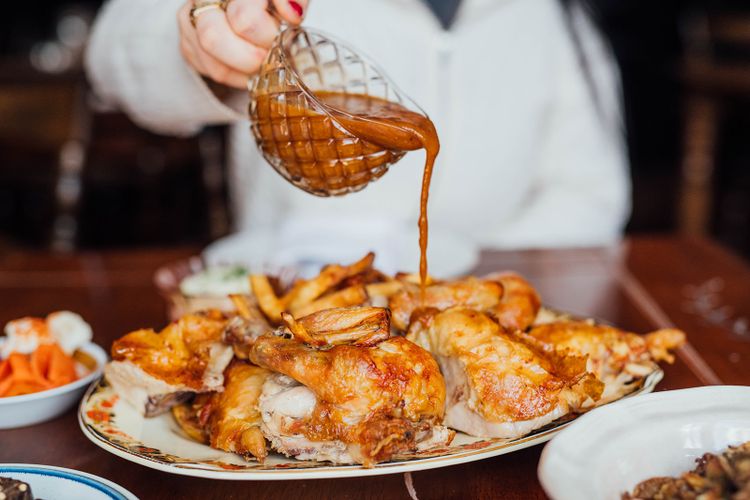
“What I do at Virunga represents my childhood. And I share that with the community that welcomed me here with open arms,” Maria-José explains. Pondu, peanut chicken, moussaka — dishes that take her back to Kinshasa. “Pondu isn’t meant to be eaten alone; it’s a gathering dish that fills tables.”
Her cuisine is broadly pan-African, drawing from culinary traditions of the DRC, Cameroon, Benin, Tanzania, and South Africa, while embracing Quebec products: duck from Marieville, guinea fowl, trout, mushrooms. The dishes simmer slowly, spices layer subtly, and the family’s multicultural heritage — Congolese, Portuguese, Indian — weaves its way into every plate.
“I grew up being told, ‘If you don’t taste it, you can’t say you don’t like it,’ and I passed that on to my children. So wherever we go, the first thing we ask is, ‘Where are we going to eat?’ Our travels revolve around the table,” Maria-José says. “You learn culturally through cuisine.”
Zoya has curated a wine list composed exclusively of South African bottles — a bold move in Quebec’s market, where African private imports remain limited. Yet she finds classic, organic, and even natural wines. “Virunga is a cuisine of love and sharing,” Maria-José sums up.
“But You’re Not Even African!”
The de Frias journey has not been without obstacles. When asked about their greatest challenge as entrepreneurs, the answer is sobering.
“As a woman entrepreneur from a diverse background, my biggest challenge was being judged for my work rather than where I come from,” Zoya shares. “When we opened, so many people told me, ‘But you’re not even African!’” Without asking questions — an aggressive gesture filled with prejudice. “People assumed I’m not African because of my skin color. But what does it really mean to be African? My biggest challenge was explaining racial diversity to people. They questioned the authenticity of our cuisine because I don’t ‘look’ Congolese. But there’s tremendous diversity at home too.”
Maria-José adds: “We weren’t given the right to be a different color, because for some, Africa is a Black continent. But in truth, there’s immense diversity.” Because of these prejudices, the duo felt they had to work twice as hard to earn the same recognition as others. “There are many clichés about our cuisine. We break barriers and introduce people to what it truly is,” Maria-José affirms.
From Recognition to Radiance
Their work has borne fruit. As early as 2017, Le Virunga was selected for catering during Montreal’s 375th anniversary celebrations. Zoya was invited to participate in Montréal en Lumière, among just 50 featured restaurants. The mother-daughter duo also took part in Soundbites at the PHI Centre. And today, Le Virunga appears in the Michelin Guide — recognition that speaks to the journey traveled since opening that small bistro with courage and limited means.
But perhaps their greatest victory lies elsewhere. In an intimate dining room with colorful tablecloths and candlelit ambiance, Maria-José and Zoya de Frias have transformed the trials of migration into an act of sharing. From mother to daughter, from one continent to another, from one culture to those eager to discover it.
And when life is good, in the de Frias family, there’s no need for a special occasion.
They simply celebrate life.
Written by Jean-Philippe Tastet