Samy Benabed: The Instinct of a Michelin-Starred Chef

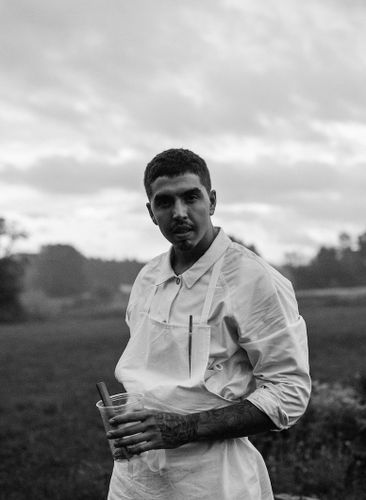
On May 6, 2026, the Michelin Guide published its Quebec selection by press release, with no gala or press conference. L’Auberge Saint-Mathieu, where Samy Benabed is chef and co-owner, earned its first star and kept the Green Star obtained the year before. He himself received the Quebec Young Chef Award. Two days earlier, the Lauriers de la gastronomie québécoise had already named him Chef of the Year. “All these distinctions in less than 72 hours, it’s extraordinary for a business like ours!”
The rooms fill up months in advance. For a ten-room inn at the edge of a lake, in Saint-Mathieu-du-Parc, in the Mauricie, that’s not one more trophy on a wall, it’s oxygen. And that’s what moves him, more than the star.
The star came, but it was never really part of the original plan. “Obviously, it makes you very proud. It gives meaning to a lot of things. But that’s not why we do this. It’s much deeper than that.” — Samy Benabed
Long before Michelin, long before the inn, long before he knew he would become a chef, there was a teenager riding his scooter to work at the pizzeria in Saint-Boniface.
Portrait of a starred chef who humbly keeps his feet on the ground.
Reflexes Before References
Born in Trois-Rivières to Moroccan parents, Samy grew up in a house where cooking happened every day. His father took over a catering service, where the kid washed dishes on weekends. It would be his first experience in the wonderful world of restaurants. Later, it was chef Dennis Bouffard who sent him behind the line at Pizzeria 67, in his very first week on the job. Other unpretentious kitchens followed. “I was lucky, I landed on chefs who had a great work ethic. Yes, it was pizza and poutine, but behind it, there was the same rigour, the same organization and the same care for doing things well.”
That’s the baggage he brought to the late La Salle à Manger, on Mont-Royal Avenue. He was hired without a single cooking diploma, while he strung together a technical degree in biomedical analysis and then a bachelor’s in philosophy. “Everything interested me back then, really everything! But everything I did, I did because I wanted to do it.”
At La Salle à Manger, Samuel Pinard took him under his wing. The menu changed almost every day, and producers delivered straight to the kitchen. “I was a real sponge. I felt like I wasn’t working, just doing what I loved.”
The Vertigo of Being Self-Taught
After three years, “I had an appetite for new challenges.” Sam, for his part, “could see I needed a bit more.” He sent him to his former chef de cuisine, Marc-Alexandre Mercier, at Hôtel Herman. Samy landed there among trained cooks who handled references he didn’t always grasp. “I felt a bit like an impostor because I hadn’t studied cooking.” He enrolled at the ITHQ and would last only one session: with seven years of the trade in his body, he understood the point of going back to basics, but “it wasn’t moving fast enough” for him.
He decided instead to build, in his own words, “his own path.” So he saved up to afford an unpaid stage at Relæ, in Copenhagen. The Danish cost of living got the better of his savings. “I didn’t stay as long as I would have liked.” Long enough, still, to validate his method: go learn wherever the call comes from. Back in Montreal, he lent a hand in the relaunch of the Réservoir, taken over by the same team as Hôtel Herman after its closure. Shortly after, Laurent Godbout was looking for a chef to reinvent Chez l’Épicier. “It was my very first chef job. I had carte blanche, I made a lot of mistakes, but I learned enormously.”
As for impostor syndrome, it dissolved somewhere along the way. “That one’s settled,” Samy confirms, laughing.
Saint-Mathieu-du-Parc, at Last
While running the kitchens of Chez l’Épicier, Samy was already dreaming of something else: the regions, closeness to producers, a return to the Mauricie. Then his friend Nicholas Trottier-Lacourse, now his business partner, told him his parents wanted to sell the Auberge Saint-Mathieu. He already knew the place, knew Saint-Mathieu-du-Parc well, and the proposal landed squarely in what he had been imagining for a while. “It would be dumb not to consider the offer,” he told himself. The next day, he called Nicholas back: “It’s a yes! Let’s do it!”
A few months later, the pandemic froze everything. Rather than slowing the project down, the pause gave them time to anchor their vision. Louise, Nicholas’s mother, also let Samy take command of the inn’s kitchen during the summers, a precious opportunity to test the project from the inside. Three seasons in a row, he found himself alone behind the line, visor on his face, with no dishwasher or commis. “It allowed me to canvass the region, understand the ecosystem and map the place.”
The acquisition closed in January 2023, with four partners. But the beginning was no fairy tale. They had to turn a home kitchen into a true commercial kitchen, renovate the rooms and absorb a pile of surprises. Three months of closure, no salary, partners tightening their belts and reservations coming in far too slowly for their liking.
Then, a few days before the May 15 reopening, Samy won the laurier for Revelation of the Year. Reservations poured in all at once and lifted an enormous weight. “It was the sparkle we needed to start the season.”
A Menu Dictated by the Landscape
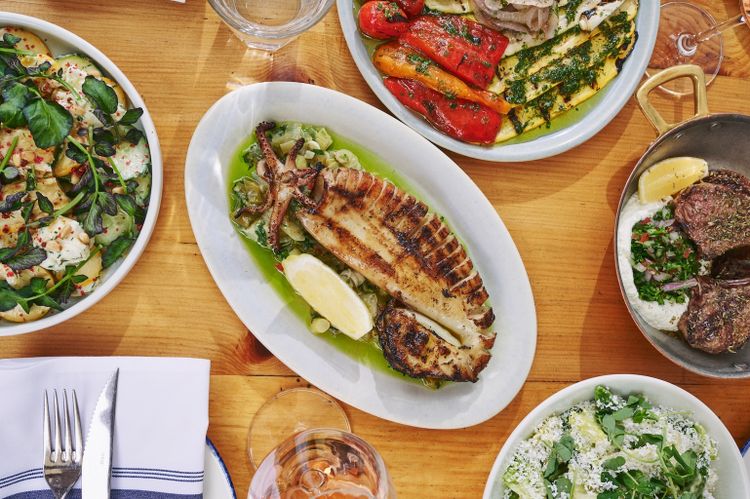
Ask him to describe his style and he’ll talk about time rather than technique. The dining room opens onto a bay window, the scenery changes from day to day, and the menu follows. “Green pea season, you blink and it’s already over.” In winter, the plates get rounder, filling up with hot broths and decoctions. What he seeks to provoke resembles a freeze-frame: a suspension of time, he says, where people feel alive in the present moment.
His inspirations work the same way; they arrive in the moment. Two days before our call, Samy came back from a farm with a big sunflower in his hands. The seeds weren’t ripe yet, the husk was still tender, and you could swallow it whole with its shell. “You don’t need to spit out the shell, it’s insane! We’re putting that in a dish!” That’s how his dishes are born, in the freedom to seize what passes by.
His Moroccan origins sometimes appear in this culinary language, without ever becoming an imposed theme: they can go back to that lamb steamed in front of him by his grandmother in Morocco, cross paths with his passion for Japanese cuisine, then with much more familiar references, like pâté chinois, when he seeks to awaken a shared memory in his guests.
An artist at heart, Samy composes hip-hop, jazz and soul beats, a path he could very well have followed. “I see cooking like sampling in music.” He draws on his memories, his travels, his influences and the products around him to compose his plates. And had this path not been his, he might have branched off into graphic design, photography or architecture. One thing is certain: “I need a vector of expression.”
The environmental-activist label, though, he politely declines, Michelin Green Star or not. Composting, minimizing waste, opening Le Comptoir (the inn’s buvette) partly to give trimmings a second life: “Some people see that as environmental activism. I just find it logical, almost innate.”
The Brigade at the Same Table
How would your team describe you? “You’d have to ask them.” Then he gives it a try: not easily stressed, very zen, quick with a joke. Even when the dishwasher breaks down and the power goes out, might as well laugh about it and find solutions. “It can come across as indifference, but it’s my way of defusing a situation and bringing the pressure down.”
“What makes me proudest is that people want to grow with us. Our retention rate is extraordinary.” ITHQ interns ask to come back before they’ve even finished their program, and he always gives them the same answer: your place will be with us once you’ve graduated. It also comes down to precise gestures: tips shared fairly among all employees, servers pitching in at the dish pit, and at 4 p.m., no matter what’s happening, everything stops and the team sits down at the same table to eat. “Everyone, without exception.”
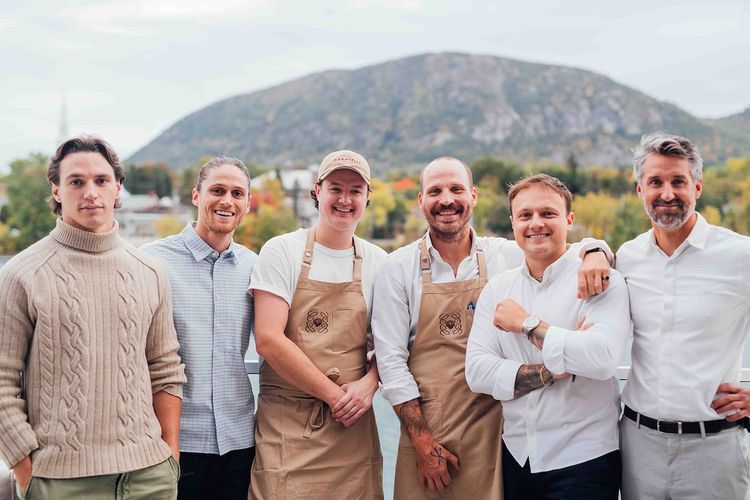
His way of growing the business follows the same logic: building around the people who bring Auberge Saint-Mathieu to life. Jana Larose, who was there from the very beginning, became his sous-chef before taking the reins of the Comptoir. The buvette was born from an idea by Florent Borrel, the third partner and manager of the restaurant. She went on to win the Laurier for Révélation de l’année, and she appeared in the brigade of the TV show Les Chefs! Étienne Prud’homme, partner and maître d’hôtel, was also nominated at the Lauriers in the service category. “What I find very rewarding is that I’m not the only one in the spotlight.”
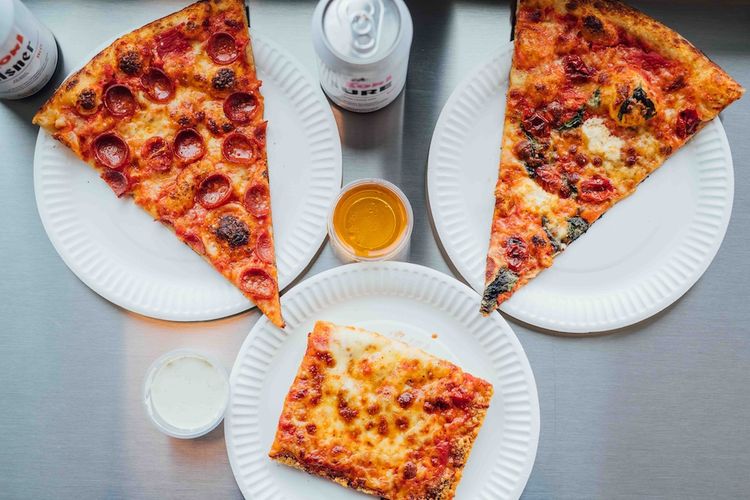
The wood-fired pizzeria located in the national park got its start with pizzaiolo Jimmy St-Cyr and was taken over this year by Christopher Lessard, a Neapolitan pizza enthusiast. An employee is crazy about bread? They’re not ruling out the idea of one day opening a bakery in the village, “so it becomes his sandbox.” As Samy sums it up: “The next step will be defined by the people who are part of the team.”
Market Gardeners, the Heart of Quebec Gastronomy
There is, however, one thing that keeps him up at night, and it’s not Saturday night service. In three years, four of the small farms he works with have had to close. Bio-intensive micro-farms, under $100,000 in annual revenue. “They become friends. Then, at some point, they can’t make it anymore, they have to close. They work like mad. The big farms get subsidies and tax credits. The micro-farms get nothing, stuck in an administrative burden designed for players bigger than they are.” He is calling on the government to act. “Market gardeners are the ones feeding Quebec. Without them, I can’t do the gastronomy I do today.”
As for what comes next, Samy refuses to draw too precise a plan. The Auberge has just acquired the house and the vast lot across the road. “The field of possibilities is infinite.”
There’s something rather beautiful in this return to first intuitions. “When I was young, I dreamed of a table champêtre. I really saw myself in the forest.”
Today, that’s exactly where he is, in Saint-Mathieu-du-Parc, surrounded by producers, by a team growing with the project and by an inn now recognized well beyond the Mauricie. He never speaks of merit, only of luck and gratitude for what life has put on his path. The distinctions have changed the scale of things, but not the way he approaches them. And when we ask him what still guides him today, the answer hasn’t moved since the beginning: “It’s to flourish by following my instinct.”
And that’s exactly what we wish for you, Samy.
Written by Jean-Philippe Tastet
Photography by Alison Slattery