Fiodar Huminski: Montréal Pizza on Top of the World

“I remember my first bulgogi. My first dumpling, my first dim sum. I remember all of it,” says Fiodar Huminski. Then he pauses, admits he’s getting emotional, and continues: “These are huge milestones for me, and I had to discover them so late in life.”
Fiodar Huminski grew up in Minsk, Belarus, a landlocked country. “At home, we ate simply: potatoes, chicken, his mother’s few signature dishes. We didn’t travel much and we didn’t go to restaurants.” When he landed in Canada with his whole family in 2005, Toronto opened up its Chinese and Korean neighbourhoods to him like a treasure chest. He describes himself as someone who was “deprived of flavour for most of his life.” Now executive chef of Pizzeria Locali and a champion of international pizza competitions, he has kept that newcomer’s hunger intact. “If I’d been born here, maybe I wouldn’t be as excited about food.”
A Slightly Too Optimistic Résumé
At first, cooking was nowhere in his plans. Before arriving in Canada, Fiodar had never cooked professionally, or even especially for pleasure. Like many newcomers finding their way, he took the opportunities that came along. In his first years in Toronto, he worked in a bakery, as a security guard and as a mover, all while building websites, his first professional field, and trying out several other jobs.
Cooking was simply another unexpected opportunity. He walked into a professional kitchen with no real culinary background and no childhood dream of becoming a chef. On his résumé, perhaps a little too optimistically, Fiodar Huminski wrote that he was a good cook. In reality, he had almost no experience. He learned bit by bit, and what started out as just a job quietly became a calling he didn’t yet know he was looking for.
The real turning point came at Tavern on the Square. On the day of his interview for a pasta station job, he showed up two hours early, found a line of candidates in the lounge and took the spot of one who had stepped out for a smoke. He sank into a couch, his hand slipped between the cushions and landed on a one-dollar bill. “I thought: this is my lucky day.” Chef Steven Leslie asked him whether he’d ever made pasta, then made the call: forget everything you know, you start tomorrow.
He would stay six or seven years, moving from the fryer to garde-manger, from fish to meat, all the way up to sous-chef. He credits this mentor with “the structure” of the cook he has become, and considers him one of the city’s most underrated chefs, a teacher whose trainees have often gone on to spread their wings. “Those who know, know.” Stages at Park and at the Cabane à sucre Au Pied de Cochon broadened his horizons, but his time alongside Jean-Michel Leblond at Tripes & Caviar played a particularly important role in his growth as a cook and as a chef. A working relationship that would eventually turn into a close friendship, still going strong today.
Pizza, Through the Back Door
Once again, it was through the Tavern’s chef that pizza came into his life. One day, the chef sent him to lend a hand at a pizzeria on Notre-Dame Street whose kitchen needed structure. Fiodar slid his first pizza into the oven there, but above all, he watched the pizzaiolo at work, absorbed in his own world. The owner became his business partner, and in 2014 they opened Le Bon Vivant together, on Notre-Dame.
Around 2015 or 2016, while still running Le Bon Vivant, Fiodar Huminski regularly dropped by No.900, where he observed how the pizzas were made and how the operation ran. He noticed in particular that the ends of prosciutto and pancetta, too small to go through the manual slicer, were sitting unused in the walk-in. He decided to grind them with sage and balsamic into a charcuterie pesto served on crostini. The idea made it onto the No.900 menu, where it is still used today.
That small initiative opened a door. Occasional contributions and consulting mandates multiplied, eventually leading to a full-time role within the group alongside executive chef Mirko D’Agata, where he became increasingly involved in culinary development.
Next came a ping-pong bar in Griffintown, a passion project set up next to the Pizzeria No.900 owned by his partner, now his wife, followed by a detour into real estate. In 2019, the couple bought a No.900 location in the Quartier des spectacles, a space several franchisees were hesitant to take on because of the high rent. They saw potential in it. At the time, they lived just behind the future restaurant and knew the neighbourhood very well, which helped convince them to take the plunge.
Then the pandemic shut everything down. With no subsidies and no leisure activities, he put on the apron. As a team of three, with his partner and a pizzaiolo, they made takeout pizzas for Uber couriers to pick up. No dining room to manage, no service pressure: the ideal training ground.
Maple Trees in Repentigny
In June 2020, the couple hit the road to get out of the city. In Repentigny, an elderly man was planting a “For Sale” sign in front of his house. Out back was a yard shaded by enormous maples, a small wooded lot. “I was sold.” Shortly after, the Terrebonne No.900 went up for sale. Its former owners, who worked in construction and plumbing, had built it with their own hands, thick marble included. A solid partnership, including an operating partner who plays an important role in its success, helped lift the location into the network’s top performers. Bernard, The Beaches in Toronto, then a location on Wellington in Verdun would follow.
Dough That Takes Its Time
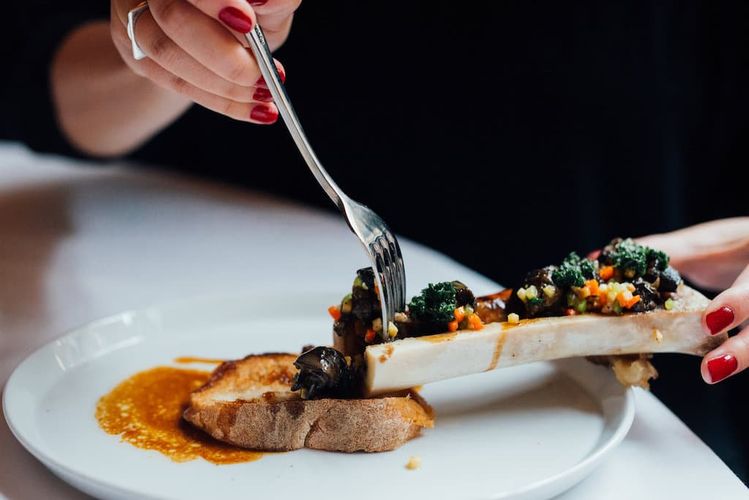
The network competes in Las Vegas, Parma, Naples and Atlantic City. Fiodar Huminski first entered a no-rules category and took first place internationally with a pizza with marrow bones rising out of it. The following year, he won gold in Neapolitan pizza in Atlantic City. When the Locali project took shape, an Italian-American pizza, he set his sights on the matching category in Vegas: seventh in 2024, third in 2025. The challenge he set himself fits in one sentence: “Beat the Americans at their own game, with Québec ingredients.” Flour, cheese, pepperoni: everything had to carry the Aliments du Québec seal, and the pizza had to stay affordable.
He spent a year perfecting the dough at home. Adjusting hydration by one point, then the salt, the yeast, the type of flour, the mixing, choosing between poolish and biga, never changing more than one element at a time. His home oven topped out at 500°F when he needed 600°F; he learned to push it beyond that.
For much of this experimentation, his close friend Jean-Michel Leblond, who is also godfather to his eldest daughter, was living with him. Jean-Michel tasted Fiodar’s countless versions of dough and pizza, and Fiodar returned the favour by testing the sandwiches Jean-Michel was then developing for his future project, Renzo. Under the same roof, the two chefs became their own test kitchens of sorts, shaping the ideas that would feed their respective projects.
He places the pizzaiolo somewhere between the chef, who cooks on instinct, and the pastry chef, bound by chemistry. “A grilled steak is basically the same whether you’re in the Empire State Building or in your mother’s basement. With dough, everything around you matters.” Altitude, humidity, temperature, season, even the spot where the dough rests: it all counts. Above all, though, Fiodar believes in giving dough time. To decode flours and glutens, he could count on the network’s chef, a fermentation buff, with whom he visited the Caputo factory in Naples.
At Locali, the dough cold-ferments for at least 72 hours. During that time, enzymes are already starting to break down some of its components. Fiodar Huminski compares the process to hosting a big dinner party and finding, at the end of the meal, that the dishes are already done: there’s simply less work left to do. “That’s what time does to dough. Fermentation has already started doing part of the work before you eat it. That’s why you can eat several slices without feeling like you’ve swallowed a brick.”
It’s also why he’s wary of pizzerias that boast about “fresh dough, made daily.” For him, the goal is maturation rather than freshness. The point of a long cold fermentation is to give the dough enough time to develop before it reaches the customer. This philosophy is at the heart of Locali’s drive to break down the image of American pizza as something necessarily heavy. “We want you to eat a lot of pizza, and still feel good afterward.”
This year, the dough left his home on a Wednesday, divided among identical coolers entrusted to four travellers on two different flights, in case a suitcase got lost or something happened to one of the batches. In Las Vegas, the gamble paid off: Fiodar Huminski and a former employee, now a Locali franchisee in Québec City, took first and second place in the world in their category.
The Same Curiosity
As Locali’s executive chef, Fiodar Huminski no longer runs a kitchen brigade day to day. He prepares the three or four menu changes each year, sources the products, listens to franchisees and hunts down every minute lost in the kitchen.
When he goes out, it’s to eat what he wouldn’t necessarily know how to make himself: sushi, a good pho, real tacos. Everything else, he cooks at home.
Nearly two decades after arriving in Canada, some of the projects now taking shape in his professional life seem to be bringing his journey back to where it began. He can’t say much yet. “Let’s just say that some of the things happening right now are bringing me surprisingly close to where this whole adventure started.”
And back home, he returns to his doughs resting in the cold, to his hydration tweaks one point at a time, with the intact curiosity of the young man from Minsk who still remembers every one of his first bites in Toronto.
Written by Jean-Philippe Tastet
Photography by Scott Usheroff