Marc-André Royal: Passionate Chef-Entrepreneur

Marc-André Royal may co-run a company with 130 employees, but you’ll still find him on the floor most of the time. His restaurant on Fleury Street, Le St-Urbain, which opened in 2008, has been part of the Michelin Guide’s selection of recommended restaurants since 2025. His La Bête à pain bakeries, meanwhile, have multiplied: there are now four, one in Ahuntsic, in Griffintown, in Laval and, since spring 2026, on Chabanel Street. Since our last conversation with the chef, the business has tripled in size. He himself calls it a “machine,” and the word is no figure of speech.
Yet when you ask Marc-André what he’d like people to remember about him, it’s neither the numbers nor the successful openings; he talks instead about his own evolution. Since then, he has learned to make room by learning to trust his team. That may well be his greatest achievement.
From the Slopes of Whistler to Fleury Street
Nothing really destined Marc-André Royal for the restaurant world. Originally from Noranda, he grew up in Montreal. At 17, his passion for snowboarding took him to Whistler, where he worked at Araxi restaurant with chef James Walt.
One day, his mother encouraged him to come back to Montreal to train as a cook at the ITHQ. “My mother told me, ‘Hey, you should go to school, Marc-André. You seem to like the restaurant business, why don’t you try the ITHQ?’ So I did the ITHQ.”
At 19, after the ITHQ, he worked at L’Express, where he learned the bistro classics. He then went back to Araxi. In all, he spent five years out West, between Whistler and Vancouver, and was notably part of the opening team at Blue Water Cafe + Raw Bar. Snowboarding injuries pushed him to leave British Columbia and return to Montreal. “It seriously slowed down my career, but that’s when the possibility of being a chef clicked in my head and chefs became my role models. I wanted to be like them and I started getting a bit more serious about that path.”
He then joined Claude Pelletier at Méditerranéo, where he spent a year and discovered a creative, rigorous cuisine. He has vivid memories of it: “Claude Pelletier is a madman — in the good sense! In the kitchen, he was 100% in it. He’s a gastronomic artist! His techniques, his commitment to not following trends, wow!”
At 28, Marc-André left for London and joined the brigade at Pascal Aussignac’s Club Gascon, a Michelin-starred restaurant. There, he discovered a very modern gastronomic cuisine from southwestern France.
Back in Quebec, he joined Bertrand Bazin and Antonio Park at 357C, a private club in Old Montreal owned by philanthropist Daniel Langlois. He kept honing his skills with a stage at Per Se in New York, under chef Thomas Keller.
In 2008, he opened Le St-Urbain on Fleury Street. “I decided to open a good little place with no pretension. And boom! We did exactly that and it took off like a rocket.” Chantal Gervais has been by his side since the very first service. The spirit has never changed.
A Bakery to Feed a Restaurant
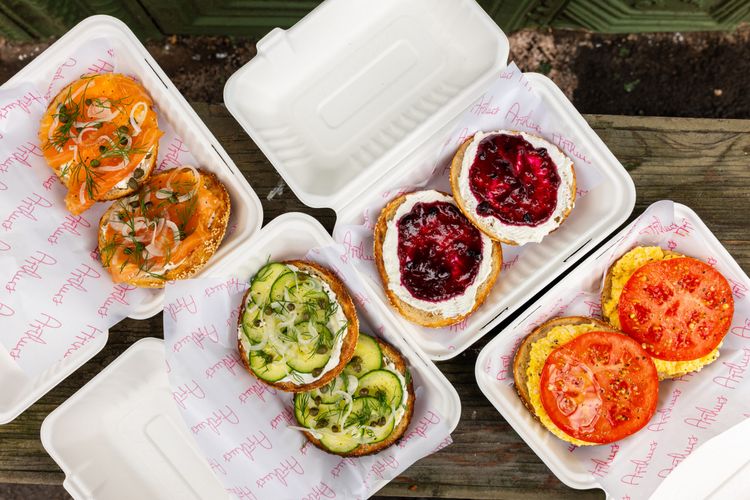
La Bête à pain was born of a very simple need: finding good bread for Le St-Urbain. About three years after the restaurant opened, Marc-André bought a bakery he had seen for sale on Fleury Street. The shop quickly became something more than an in-house supplier. In 2016, the team at MUST Maison Corbeil invited it to Griffintown. Then, in January 2019, the business crossed the bridges and set up shop in Laval.
The Laval location was a “smash hit” from day one, he says. Nearly a year later, the pandemic upended the plans: in Ahuntsic, the dining room on Fleury Street had to close, leaving only the shop. Laval, for its part, kept on climbing. Today, it runs at full tilt, to the point of having reached full capacity. “I think it met a need,” Marc-André points out.
Chabanel, the Business Expands
It’s precisely because the shops are overflowing that Chabanel became necessary. For years, La Bête à pain has supplied hotels, golf clubs, restaurants and butcher shops. But orders were going out from all over, from Griffintown, Laval and Ahuntsic, with the small variations that come with artisanal work: a different oven, a different hand. Serving businesses and neighbourhood customers under the same roof was becoming a headache.
The solution: bring the entire commercial clientele together under one roof, on Chabanel Street. Designed on a single level around a larger oven, the space allows production to be organized with a new level of precision. It’s also from there that all deliveries to commercial clients head out every morning. A viennoiserie workshop, equipped with an automatic dough sheeter, marks the business’s entry into a more technological era. The breads have even made it onto the shelves of a few IGA stores in the city, a world where packaging and logistics follow different rules. Freed from that pressure, the other shops can devote themselves fully to their neighbourhood customers.
Up front, the Chabanel shop welcomes some 300 customers a day during the week, mostly people who work in the area. On weekends, the atmosphere changes completely: families from the surrounding neighbourhoods gather there, happy to have a dining room close to home. From time to time, a jazz or folk musician sets up in a corner of the room, a touch inspired by his travels, during which he always seeks out places brought to life by live music.
Since the opening, Chabanel Street is where he spends most of his time. For months, he took his place back in the kitchen, making sure every recipe was executed with accuracy and faithfulness. Around him, the young bakers from France are bursting with ideas and dream of inventing. “I have to keep a guiding line: what is La Bête à pain’s identity.” Evolving without rushing things, offering a product people recognize from one visit to the next, so that everyone comes back knowing exactly what to expect. The baguette, which he immediately names as the house classic, is the best proof of that.
Three Heads, One Table
If there’s one thing Marc-André Royal insists on, it’s that he never built all this alone. If he has become the face of the business, it’s because his two partners somewhat prefer to stay in the shadows. But from Le St-Urbain to Chabanel, none of what has been built would have been possible without them.
Chantal Gervais, his partner in crime since the very beginning at Le St-Urbain, oversees hospitality, customer relations and the world of wine. Annick Dufresne, his spouse, holds the reins of administration: finance, hiring, human resources and planning. A “huge amount of work behind the scenes,” he points out, the work that keeps the whole machine running. He remains the man on the ground, guardian of production, cuisine and quality. “You don’t put me in an office, that won’t fly.” Three complementary strengths, inseparable from one another.
This balance has allowed the business to grow without losing its footing. Back then, some thirty or forty people revolved around Le St-Urbain and the first shops. Since then, the company has built a real structure: internal departments, occupational health and safety training, structured salary reviews. Tensions, once settled by instinct by a chef with no training, now find better-equipped answers. With 130 employees, running the business has become a profession in its own right. “At some point, you don’t have a choice.”
Le St-Urbain, a Neighbourhood’s Pride
At Le St-Urbain, Lindsay McLaren has been running the kitchen for many years, and Marc-André trusts her “100%.” In this dining room of about sixty seats, seafood platters remain the signature, while the chalkboard menu evolves every week in small touches.
Just like La Bête à pain, Le St-Urbain is committed to preserving a clear identity. It rests on a French-inspired market cuisine, resolutely Québécois, sourced from small farms and, as much as possible, local fish.
Beyond the Michelin Guide recognition, it’s the neighbourhood’s pride that moves him. Far from being a tourist spot, Le St-Urbain welcomes Villeray, Ahuntsic and the North Shore, often meeting halfway: a young downtown professional and their parents coming in from Lorraine or Blainville. For some, the guide has become a mark of trust, “a safe bet.” For the regulars, the distinction mostly tasted like a collective victory, one for the whole neighbourhood.
What Has Been Your Biggest Challenge in Recent Years?
Without the slightest hesitation: “Immigration and hiring specialized staff,” Marc-André tells us. The business recruits a good share of its bakers and pastry chefs in France, for lack of enough local workers trained in artisanal baking. Out of some 130 employees, La Bête à pain counts about fifteen bakers from France, all in key positions. Heirs to the tradition of sourdough, baguette and pain de campagne, they bring an expertise that Quebec struggles to develop, its few baking schools training mostly for industrial production.
Still, you have to be able to bring them over, and keep them. Openings, closures, new rules: the immigration landscape has shifted with every administrative reversal, suspended visa and weakened team. “We can’t afford to lose half of our employees.” Driven by Annick, the business built an entire pipeline: a headhunter in France, an immigration lawyer, an apartment in Ahuntsic to welcome newcomers. “It brings us super-qualified employees to build the machine, because our machine runs hard.”
The situation has stabilized, but the fear of another reversal remains. To governments, he sends a clear message: precise rules, designed to last. “We just want stability so we can plan ahead.”
After Growth, Balance
No new project on the horizon (for now)… “We took a big bite with Chabanel.” Now is the time to consolidate, to refine the brand, to polish every detail of a business that expanded quickly. A pause that has nothing to do with running out of steam: rather, a time to let the roots settle in.
If his journey is as “rock-and-roll” as the man himself, you can’t help but admire his entrepreneurial spirit and the conviction that drives him to fight for his dreams. Over the years, he has built a business that supports more than a hundred people in Montreal and the surrounding area, while offering us quality products to enjoy in pleasant spaces.
“We’ve reached a point in our lives where it’s starting to get really interesting,” he confides. The company has found its size, the team its rhythm. Deep down, the passion remains the same as on day one: “Everything about food still fascinates me.” But it’s lived differently, with more listening and more trust in the next generation. After all these years, never holding the helm alone, Marc-André Royal may have finally found his balance.
Here’s to your wild spirit and your projects, Marc-André!
Written by Jean-Philippe Tastet
Photography by Érable du Québec