In collaboration with Loto-Québec, we’re bringing you a series of portraits of chefs who trained at ITHQ.
It’s February 2016 somewhere in Lac-Saint-Jean, and maybe it’s snowing outside, who can remember. In biologist Fabien Girard’s living room, two young cooks lean in toward a tiny vial, no bigger than a pencil eraser, five milliliters at most. François-Emmanuel Nicol takes a breath. He turns to Jérémy, his pastry chef. Their eyes go wide at the same moment. It smells like almond. Except we’re in Quebec, and there are no almond trees in Quebec. There is, however, the cherry birch (a quiet little cousin in the great boreal forests), and it’s in its bark that this sweet almond fragrance lies dormant, in filament form, taking an entire season to gather.
“If I take the bark, I kill the tree. That’s not how I work.” It’s Fabien Girard speaking, and he calmly explains to the two cooks that to produce the quantity they’re already dreaming of (an almond ice cream, perhaps!), he’ll have to call the municipalities, scout out forestry cuts, get there ahead of the loggers… In short, wait a year and a half. That’s the timeline. François-Emmanuel nods. He has just understood something he’ll never forget: working with the wild means waiting. It means being patient, and respecting nature’s rhythm.
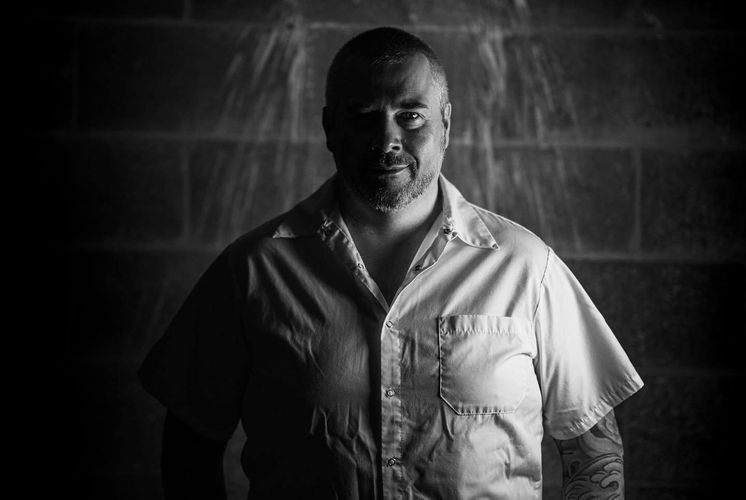
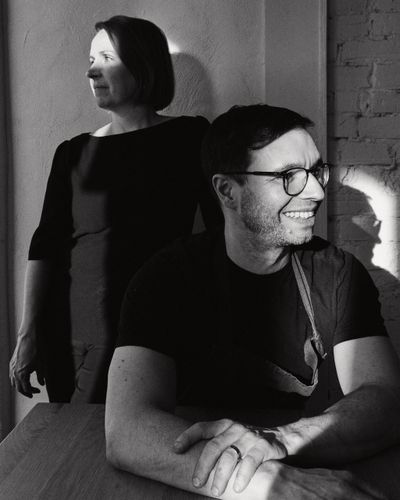
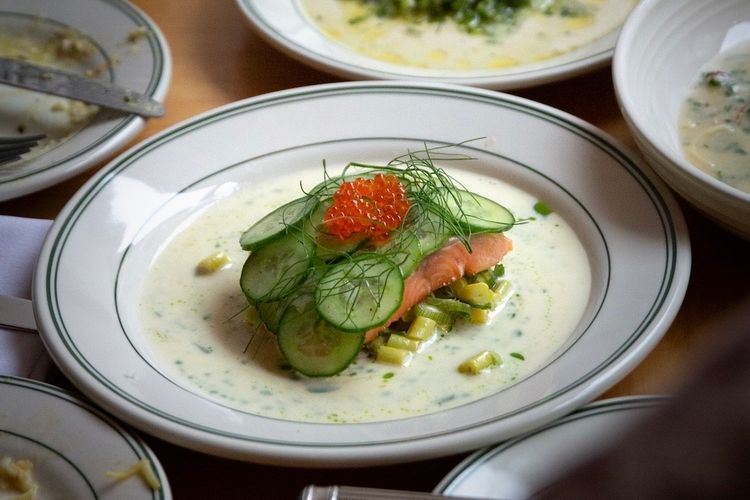
Ten years later, that detail, that vial no bigger than nothing, captures better than anything else the work being done at Tanière³, the restaurant he opened at the foot of Old Quebec in March 2019, exactly one year to the day before the pandemic began. Today, at 35, he is the only chef in the province to hold two Michelin stars. His restaurant ranks third on Canada’s 100 Best 2026 and fifth in North America on the 50 Best list. The dining room has been fully booked every night for a year. And yet, what still lights him up isn’t the rankings. It’s still, and always, what grows, runs, or can be foraged within two hours of the restaurant: the boreal forest, the producers he knows by their first names, an ingredient he had never tasted before this season.
Potatoes, ketchup, ham
The story actually begins far from the boreal forests… In Matane, rather, and even a little further. His parents are Breton, having arrived in Quebec in the 1970s to work in seafood marketing. His mother worked in quality control at the shrimp processing plant. She would send back entire boatloads, full of shrimp the fishermen hadn’t bothered to ice. She was called a “damn French woman.” Someone, one day, threatened to throw her in the water! But for her, the freshness and quality of the product came before everything else. At the family table, they talked sourcing, they talked terroir, they talked sustainable fishing long before those words became fashionable.
He, little François-Emmanuel Nicol, couldn’t have cared less for a long time. He was a difficult child (yes, yes, you read that right!). “For a long time, I ate potatoes, ketchup and ham,” he tells us, to our great astonishment. “My mother still tells that story to every parent who has picky eaters!” he says, laughing. As proof that one should never lose hope, that things get better.
The awakening came in adolescence, by chance. At 15, he was making breakfasts at the Cosmos, and he was cranking them out at a frantic pace, which appealed to him less. He decided to leave the kitchen and went to drop off his CV at a grocery store. The manager read it, looked at his experience, and smiled: “I don’t have anything for you, but I’m in the middle of opening a little café.” The chef running that little café took him under his wing, gave him an unbelievable amount of room to maneuver: a daily breakfast special, his to compose as he saw fit. During his chemistry classes at CEGEP, François-Emmanuel was planning his menu instead of listening to the professor. There was nothing to be done; the passion was now firmly rooted in him.
Rather than pure cooking, he chose management at the ITHQ. He wanted to understand the machine. “It was already important for me to be able to have my own restaurant one day and to be able to manage it, not just hold up a kitchen,” he explains. During his school years, he came up to Quebec City every weekend to work at Panache at the Auberge Saint-Antoine, in the era when the house was shining. He took part in the first edition of the San Pellegrino Young Chef competition. He won the Grand Chef Relais & Châteaux scholarship. And then he was off: to explore, taste, cook. Quay in Sydney. Arzak in Spain. Mauro Colagreco’s Mirazur in Menton, on the French-Italian border.
It was there, in the kitchen overlooking the Mediterranean, that he crossed paths one evening with Alex Atala, the great Brazilian chef, who had arrived with a variety of Amazonian products unknown to the entire team. A day of cooking François-Emmanuel would never forget. And a sentence from Atala that would stay lodged like a nail: “The day we started getting interested in Latin America at the level of cuisine was when we stopped making French and Italian food, and started making South American food.” It resonated with him, with Quebec gastronomy, and he knew it was time to come home.
He pushed open the door of Légende and dropped off his CV. Frédéric Laplante, one of the owners, was convinced: “You’re not walking out of here. We’re going to reopen Tanière together.” That was in 2015. Three years later, they signed the lease on a bankrupt space in the stone vaults of Petit Champlain — a former 17th-century fur warehouse, turned discotheque under Quebec City’s first Hilton, on the site of the city’s very first port, in 1686. They had no idea they would make Quebec gastronomic history there.
The rain before the sunshine
Tanière³ has not had a smooth trajectory. Before being full every night, they put in the hard work. There was the pandemic, twelve months to the day after opening. There were the years when, like good restaurateurs, they pulled hard on the rope to move the project forward. There were moments when he could have given up, and when he held on, out of stubbornness, out of loyalty to the place, out of that tenacious conviction that there was something important to build there, beneath the vaults.
And then there was Michelin. Toronto and Vancouver had received it, Montreal would follow… and Quebec City would have been left behind. For François-Emmanuel Nicol, missing out on the prestigious guide was unthinkable. In his view, Quebec City also deserved to shine. One afternoon, in the middle of mise en place, François-Emmanuel Nicol got in his car, made the rounds of the city’s kitchens, and presented a letter of intent to 14 chefs in a matter of hours. He then handed it to Mayor Bruno Marchand at a cocktail event at city hall. “When a politician tells you he’ll get back to you, you don’t have high hopes,” he recounts, with a touch of humor. He was wrong: the machinery started turning.
The decisive debate took place at the Château Frontenac, in the presence of Normand Laprise, Hugues Dufour, and Fred Morin, who was fiercely opposed to the guide. When Morin declared that he didn’t want to “light a fire under his team’s ass because of a guide,” François-Emmanuel Nicol sensed the room wavering. He was 30, intimidated, surrounded by peers who had inspired him in his early years. “What you just described is a cliché. Stars have never, on their own, set the mood of a brigade. That’s a personality trait, and a company culture.” Silence in the room. Normand Laprise stood up to back him. Antonin Mousseau-Rivard did too. The vote passed.
A year later, the restaurant earned two stars right out of the gate. The first (and only) address in Quebec to hold them. Last Wednesday, May 6, 2026, the Michelin Guide revealed its crowned restaurants for the second edition. Same verdict: Tanière³ remains the only table in the province to be doubly starred. Still unmatched. There’s something, at the end, that he slips in almost by accident, while speaking about ambition in Quebec: “We have a bit of a problem of being born for small things. It’s almost frowned upon to name high goals.” He wasn’t afraid of it. At 27, François-Emmanuel Nicol had told his investors he wanted to one day make it onto the 50 Best list. Seven years later, he’s there, fifth.
What remains is that vial, sitting somewhere in a kitchen in Old Quebec, that smelled of almond without being one. Everything is there, perhaps: the idea that a forest you truly look at always ends up offering what you didn’t dare hope to find in it. Provided you respect it. Provided you wait… and work very, very hard while you do.
Written by Jean-Philippe Tastet
Photography by Tanière3