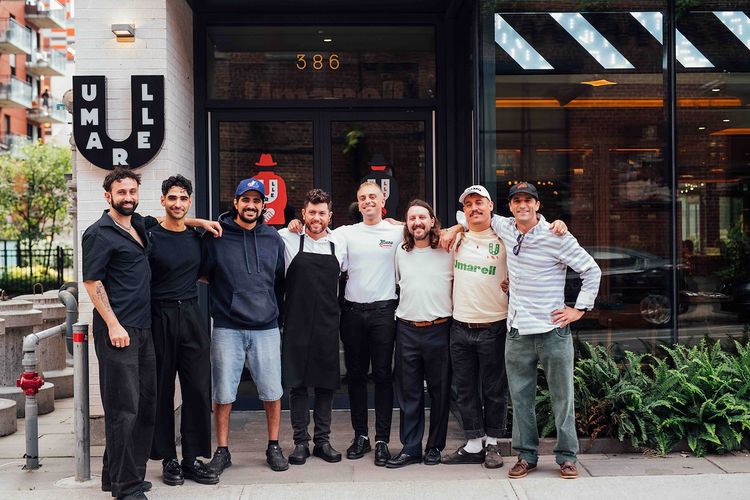
Daniel Lo Manto : building Bossa one sandwich at a time

Some restaurateurs dream of empires. Daniel Lo Manto dreamed of a street corner. One shop, one counter, and him behind it, making sandwiches for the rest of his life. “I always thought it would just be one store and I would go in every day and just make sandwiches. I would be that guy at the corner that everybody knows, even 40 years from now, still making them. And I was happy with that.”
That is the tension running through his whole story. Eight years after opening Bossa with his mother on Wellington Street in Verdun, the dream of a quiet little counter has swelled into four addresses (soon to be five!!) a bakery pushing out more than 3,000 loaves a night, and a team of 150 people. At 31, Daniel runs all of it without ever really sitting down. “I never visualized this for myself,” he admits, still stunned by his own path. “Even when we opened the first store, I never thought it would grow into something like this.”
The paradox follows him everywhere. He has built a thriving business, yet he almost physically refuses the word “chain.” To understand how the guy who wanted to stay small ended up at the head of all this, you have to go back to one specific kitchen: the one from his childhood.
A childhood at counter height
Cooking, for him, was a reflex long before it was a job. Daniel Lo Manto started cooking at four years old. “My parents would have to stop me from going into the kitchen,” he says. He would wake up before everyone else to fry himself eggs and bacon. His grandparents, who had come over from Italy, had been farmers, and they carried a whole knowledge of preservation with them: tomato sauce, wine, soppressata, sausages, made together every single year. Little Daniel was part of all those joyful chores. “Food was always at the center of what we did. It’s what brought us together.”
As a teenager, Daniel Lo Manto was already the one who fed the crew. On a Friday or Saturday night, whenever a house opened up, his friends would pile in and he would put up a big plate of pasta for everyone. Except that, back then, cooking was still a pleasure, a side passion. “I never once imagined making a life of it”. He was studying marketing full-time at John Molson, working at RBC, and picturing a future behind a desk.
The turning point came down to a phone call. His childhood friend and neighbor Joey D’alleva, then the chef at Suwu on Saint-Laurent, got stuck one evening when a prep cook called in sick. He called Daniel almost at random, just for a hand. “That was the first time I ever worked in a kitchen. I was 18, turning 19. And I fell in love with the restaurant industry.” He quit his job the next day, became a part-time student, then dropped out for good. He was two classes short of his degree. He never finished them. For four or five years he followed Joey from kitchen to kitchen and picked up a line that would become his compass: elevate everything you can, always one notch higher.
The fire, then the sandwiches
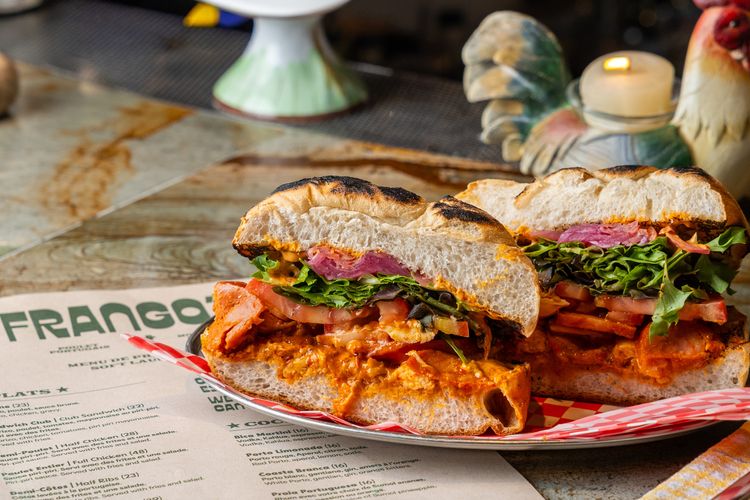
Bossa was supposed to be something else. In 2018, on Wellington Street, Daniel Lo Manto opened a fine-food grocery with his mother, built around Italian imports and prepared meals. Two months later, a fire forced everyone to sit down and rethink the whole thing. The shop was not busy, and he was already bored of repeating the same dishes. The way out came straight from his own childhood: sandwiches.
The first four are postcards from his youth. The sausage draws on his weekly trips to Milano’s with his father. The chicken cutlet points back to Parma, where he ate lunch during his Concordia days. The meatball comes from Nino’s, a pizzeria in Ville-Émard where his grandfather once worked. His grandmother, for her part, used to make him soppressata or mortadella sandwiches. Then he layered on something from elsewhere: a big part of his father’s family lives in Philadelphia, with its own culture of cold cuts, mayos and pickled vegetables. “In Montreal, before Bossa, it was either the traditional Italian sandwich or the French-style sub. There was no in-between.” The chicken parm would be his first viral hit, at a time when nobody else in the city was making one.
His way of cooking still carries Joey’s lesson. No raw red onion when you can pickle it; vinaigrettes, pickles, mayos and proteins all reworked one by one. When his partner Fabio, who came up through Antonio Park’s kitchens, joined the project, he pushed those recipes further still and made them work at scale. “He’s the most creative chef I know,” Daniel says, without a trace of envy, like a man who knows how to surround himself with people better than he is.
A business shaped like a family
At Bossa, the org chart looks like a family dinner. Both of his parents work there, alongside his partners Fabio and Luca. His cousin Mike is also part of the company, while his sister-in-law Sarah makes the desserts. His aunt Joanne has run the Verdun counter since day one, a local celebrity the whole neighborhood greets by name. And then there’s Antoinette, who has been with Bossa since the very beginning and has, over the years, become part of the family too. His wife Sabrina led the brand overhaul, giving it coherent colors, a typeface and a voice “without turning it into a chain or a franchise.” They are now 150 employees.
Working with his mother remains, for him, a rare privilege. “People my age don’t get to see their mother every day. I see mine from morning to night.” Their disagreements come down to two tempos: he charges, she tempers. “Two mindsets working together, old school and new school. I think that’s a beautiful thing.”
He himself has ended up fused with his shop. “There’s no managing my work life with my personal life. My work is my personality. It’s who I am. Everybody knows me as that guy, the Bossa guy. That’s what I live and breathe.” He is only just learning to carve out other pleasures: photography, and above all a huge garden he slips into at 5:30 in the morning for an hour before the world stirs. “Very Italian, yeah,” he concedes, laughing.
Staying small while growing
He resists the pull toward excess almost physically. “I don’t want a thousand locations. I just want a couple of really solid spots.” Serve Montreal properly, fill in the city’s map, maybe reach Laval, Little Italy, downtown. Toronto or Quebec City one day, if he still loves it. But the second the quality is in jeopardy, he says, he would stop, no hesitation.
Underneath the entrepreneur, there is still a cook who misses the heat of service. The kitchen misses him too, he keeps saying, those nights working until midnight glued to the stove with a small crew, getting crushed by the rush. But he has come to understand that another fire holds him just as tightly. “Then it turned into something so much different. I realized I actually have a passion for being an entrepreneur too, not just for cooking and dealing with food. I just feel fortunate and blessed that I get to experience it.”
His gratitude quickly spills over onto the people who put a spotlight on his trade. “Ten years ago, what we do went completely unnoticed,” he notes. “The only thing people cared about was reviews in the newspaper. Now it’s so different. There’s this beautiful network that got built, and it’s people like you who really opened it up.” Then he hangs up, behind on his emails but right on time for his life, and heads off to his next site. The four-year-old who woke before everyone else to cook never really left the kitchen at all.
Written by Valérie Boutet
Photography by Scott Usheroff